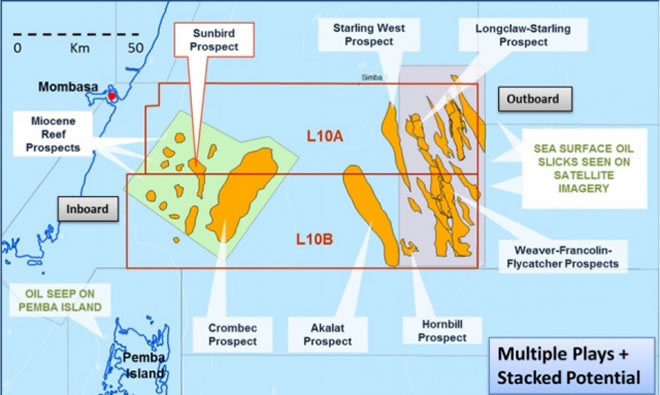
Map showing the prospect sites (Pancontinental Oil and Gas press release)

Monday, June 30, 2014
First ever oil discovery off Kenya's coast, says Pancontinental Oil and Gas
We believe that this is a play-opening discovery in Kenya’s Lamu Basin.” According to Pan-Continental Oil and Gas, the Sunbird-1 oil well which is in the southern Kenyan coast has “intersected an oil column”. “The gross oil column is assessed to be 14metres thick beneath a gross gas column of 29.6m in a reefal limestone reservoir in the Sunbird Miocene Pinnacle reef in area L10A,” reads a communiqué released by Pan Continental Oil and Gas. Pancontinental which is listed in the Australian Stock Exchange (ASX) has interests in three license areas in Kenya’s offshore covering some 15,557 sq km. These are in Blocks L6, Block L10A and Block L10B.
In the 4962 sq km Block L10A in the Lamu Basin Pancontinental which controls 18.75 per cent, PTTEP Australasia which is a subsidiary of Thailand’s national oil company controls 31.25 per cent and the London Stock Exchange listed BG Group which is the operator of Sunbird-1 holds the largest stake of 50 per cent. In September 2012 a consortium of Pancontinental, Tullow Oil of UK and the US-based Apache Corporation announced that they had discovered significant amounts of gas in the Mbawa-1 well in offshore Kenya’s Block L8.
The exploration costs on Block L8 alone were estimated to have cost some $135 million. According to findings by Pancontinental which has so far participated in five 3D surveys in offshore Kenya, the prospects are promising. Considering that Lamu Basin is part of the western Indian Ocean rim, this news was expected. In the last five years major offshore hydrocarbon discoveries have been made in the western Indian Ocean rim nations.
In Mozambique more than 120 trillion cubic feet (tcf) of natural gas has been discovered in the Ruvuma offshore basin while neighbouring Tanzania has between 20 to 30tcf of natural gas deposits. Oil majors Anadarko, ENI, Total, Statoil, PETRONAS and BG Group have significant interests in the entire western Indian Ocean region. Sharing a similar ecosystem is the reason the oil find in Kenya’s offshore was expected. And this is not an isolated incident as the region has in the recent past become a focus of the hydrocarbon industry.
Indian Ocean islands eye potential finds The other western Indian Ocean nations of the Comoros, Madagascar, Mauritius, Reunion and Seychelles are also keen to exploit their hydrocarbon’s potential. In Madagascar the world’s fourth largest island, intense exploration is currently on-going with more than 15 oil and gas companies involved in exploration activities. Comoros on the other hand has already demarcated 40 oil blocks with several offshore blocks being awarded to Kenyan, Comoros and Mauritius’ firms. The Seychelles and Mauritius are also currently engaged in the setting up of an authority which will jointly licence and oversee petroleum exploration in the Joint Management Area that the two countries own in the Mascarene Plateau. This is aimed at forestalling future maritime disputes between the two nations.
In 2008 the two countries lodged a joint submission for the extended continental shelf with the UN Secretary General which was granted in March 2011. In March 2012 Seychelles President James Michel and Mauritius Prime Minister Navin Ramgoolam signed the treaties for the joint management of the continental shelf measuring slightly 396,000 square kilometres off their respective coasts. According to energy analysts the region is expected to become an energy hub in the next five years.