By Lindsey Howald
Sunday, February 09, 2009
 |
| Photo by Nick King |
“Where’s Ali?” his father would ask, searching for him throughout the house. Halane’s sister and his four brothers would be easily accounted for — all future scientists, they were diligent students in reading and studying. Halane could also be found scribbling on notebook paper, but he was sketching faces, not solving math problems.
“One time my father said, ‘Every time I see you just drawing. When do you do your academics? When do you study? All you do is just draw,’ ” Halane said. “I’ll never forget that.”
Although he had no opportunities to formally study visual art in his country, Halane found other ways to learn. He sought out the homes and studios of the professional artists living nearby. Whether they were painters or designers of billboards, political posters and cultural stamps, they provided the inspiration and company the young Halane sought. But when Halane came to the United States in 1984 to further his education, it didn’t even occur to him that he might be able to study art.
After spending several months living in Bloomington, Ill., with cousins, Halane scraped up enough money to enroll in college that August. He entered his first year at Lincoln University in Jefferson City assuming he would study business, but when he discovered with surprise an art department, he enrolled in painting and ceramics courses and never looked back. In 1994, he went on to earn a master’s degree in fine art from the University of Missouri.
Meanwhile, in Somalia, the political climate boiled over. In 1991 its government collapsed, and the country has been in a state of turmoil ever since. In nearly 25 years, Halane, who now lives in Sedalia with his wife and three children, has never returned to visit his home.
“It was very safe” before, “and there was nobody killing nobody, and now it’s just — oh, my, it’s a mess,” Halane said.
She can name off the two rivers that run straight through the country and cite the news articles she reads to catch up on the political and cultural developments, but Carla, Halane’s wife, has never been to her husband’s homeland either. They met, Ali Halane says, on a blind date.
“Well, that’s his story,” Carla said. She’s a sweet black woman who has spent her entire life in Sedalia and has worked in the post office there for about 20 years. “But my story is when we both went to Lincoln University, I was walking with a girl and saw him walk across the campus. … And she happened to know him; she was a friend of his. I told her, ‘There’s something about him. I’m going to marry him someday.’ ”
Carla and her relatives often provide much of the subject matter for Halane’s African masks and portraits. He prefers to depict people he knows well, hoping to capture intricacies in facial expressions that only one with an intimate knowledge of that person could recognize.
“You can capture expressions of someone’s face … beyond what you see,” Halane said. “Whether they are happy, whether they are angry, whether they are worried … there are deeper things.”
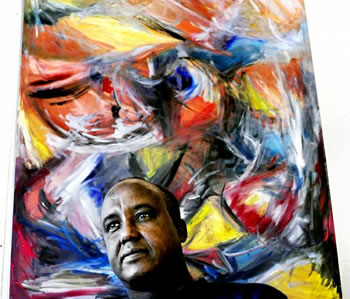
There are even faces, he claims, in his abstract paintings. With an accent he jokes he’ll never be rid of, Halane talked his way through one of them hanging in Sven’s Kafe & Gallery’s February exhibition, called “Chameleon III.” The lines of texture are incredibly active and alive in the painting, and the colors are bold and mineral-rich, mimicking at times the earthen reds and browns of African clay. Inside the hurried and vibrant abstract forms, Halane can point out the places a face, eyes, torso or nose might emerge.
His handmade masks, rough clay vessels and sculptures are fired through an ancient process called pit firing. Fueled by paper, sawdust and other combustible materials, an open fire is used to slowly bake the clay to a hard, finished state. Halane controls the areas of the piece exposed to oxygen; the result is a surface scorched and ashy with carbon in some areas, cool and smooth in others. Because the heat is less evenly distributed than if the clay were placed in a traditional kiln, the surface will occasionally crack. Halane, however, delights in these irregularities, and his work carries an intentional hint of the rudimentary.
Much of his work is a conscious reflection of his home country. Two of his ceramic pots he named “Shebelle River” and “Juba River,” after the two rivers running through south-central Somalia and enriching the surrounding land.
In Somalia, “we do a lot of ceramics, and we use ceramics as a functional object — carrying your water with it and all that,” Halane said. “It’s something I always saw.”
Source: Columbia Daily, Feb 08, 2009