The Kansas City Star
By MALCOLM GARCIA
Sunday, September 07, 2008
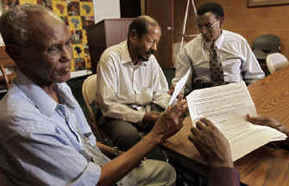
Mohamed Yusuf (left) and Hassan Warsame worked on improving their English skills, helped by Farah Abdi (right), executive director of the Somali Foundation in
Hassan Warsame’s command of English goes no further than three basic questions:
What’s your name? What’s your address? What’s your telephone number?
A native of
“My goal was to master English,” said Warsame, 68, speaking through a translator, “but I know only this little.”
He may need to learn more. Pressure on non-English-speaking people living in the
But getting everyone to speak English proficiently will not be as simple as it might appear. Many refugees like Warsame are illiterate in their native languages, increasing the challenges they face learning to read, write and speak a second language. Consequently, some of them get trapped in low-paying jobs that keep their families in poverty and dependent on government assistance.
The country’s “limited English-proficient” population has ballooned from 6 percent in 1980 to 12 percent in 2000 — meaning that about 25 million adults need help understanding everything from school permission slips, telemarketers’ pitches and food labels to bills, job applications and doctors’ prescriptions.
In
Since 1991,
Farah Abdi, executive director of the Somali Foundation in
“The situation is not the result of an inability to learn, but the barriers to learning,” he said. “If a teacher understands the history of these people, the psychological traumas they’ve experienced and understands the language, it would help. Cultural competency is crucial.”
Finding enough bilingual teachers for each nationality probably is impossible because of funding constraints, said Judy Akers, executive vice president for Della Lamb. The nonprofit agency provides English language classes and other services.
“We have a lot of different cultures here and no money to employ translators for each culture,” Akers said. “It’s important that they mix with one another so they know they’re not in this alone.”
According to the U.S. Department of Labor, there are more than 24,000 translators nationwide, but there still are not enough to represent the more than 300 languages spoken in the
Critics contend that the only barrier to learning English is desire. If they come here illiterate, we don’t expect them to declaim the King’s English tomorrow, nor should we,” said Jim Boulet Jr., executive director of English First in
In a recent survey of 314 Somali households in
“There are a lot of issues they face,” said Karen Janas, director of refugee services at Jewish Vocational Services. “They’ve been in camps a long time. Some have two generations of kids raised in camps with little schooling. They come here and are supposed to be self-sufficient. It’s real hard with the language.”
A 1995 study by George Mason University professor Virginia P. Collier found that “non-native speakers of English with no schooling in their first language take seven to 10 years or more to reach age and grade-level norms of their native English-speaking peers.”
The
“You learn to read once,” said Alicia Miguel, director of language services for the district. “Once you know how, you can transfer those skills to a new language. We have students, especially older ones, who have to learn a new language and the concepts of literacy without having trained their brain to think this way in their own language.”
Warsame has all but given up learning English. Before coming to the
“I worked and went to school and never understood English,” he said. “If something is simple, I can ask and someone will help me. If I have an important appointment, I need a translator. I still work, but I don’t go to school. I am not a burden.”