
By MOHAMED OLAD HASSAN
Thursday, December 04, 2008
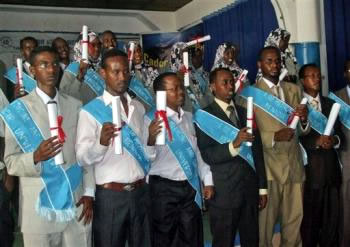 |
| Newly qualified Somali doctors hold their certificates during a graduation ceremony in Mogadishu, Somalia, Thursday, Dec. 4, 2008. (AP Photo/Mohamed Sheikh Nor)
|
The graduation ceremony for 12 men and eight women was held inside the barricaded walls of the Shamo Hotel in Mogadishu, the bullet-scarred capital of a country that has not had an effective central government since 1991.
"The graduation of these students shows something that nobody outside Somalia can believe — that students can still learn despite violence and anarchy," said Mohamed Malim Muse, president of Mogadishu's Benadir University.
Civilians have taken the brunt of the violence — thousands have been caught in the crossfire, killed or maimed by mortar shells, machine-gun fire and grenades.
Earlier this week, Mogadishu got its first public ambulance system in 18 years, raising hopes residents will no longer have to resort to wheelbarrows to transport their wounded.
"Every morning I was risking my life to reach the university, and about seven times I was trapped under crossfire," said 19-year-old Hafsa Abdirahman Mohamed, whose mother lives in London and helped her pay the $1,500 annual tuition.
"But that did not stop me, and now my dream is real," she said.
The United Nations says there are around 300,000 acutely malnourished children in Somalia, but attacks and kidnappings of aid workers have shut down many humanitarian projects.
"If we get a good and functioning government we can be a leader among African universities, regardless of security, because we know how to survive in anarchy," said Abdirizak Yusuf, 25, head of the medical students' association at Benadir.
With the men wearing suits and ties and the women in Muslim headscarves, the graduates smiled for a portrait and hoisted their diplomas in the air after a six-year program that is recognized only in Somalia, not overseas.
Somalia is notorious for its violence and poverty. But through nearly two decades of violent anarchy, life has carried on in this gun-riddled country, where militiamen rule the streets and piracy flourishes off the lawless coast.
Despite the lack of a functioning government, there is electricity for those who can afford it, wireless Internet access — even a university education, some five years after the education ministry made a push to reopen some schools.
Somali's deputy foreign minister, Abdikarin Ahmed Ali, was among those attending the ceremony.
"I am very grateful for the teachers and parents who have shown dedication and resilience to educate and produce qualified doctors and teachers, despite the insecurity and lack of funds," he said.
Source: AP, Dec 04, 2008