
Thursday, May 10, 2007
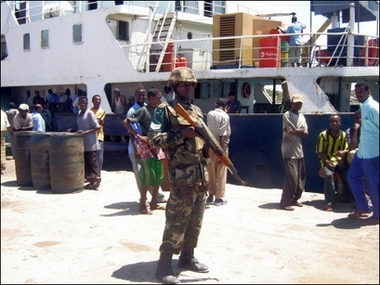 |
| Ugandan Africa Union peacekeepers patrol the international sea Port in Mogadishu, 8 May 2007. |
The port is the lifeline of a city battered by 16 years of civil war -- food is brought in this way, and so is all the fuel needed for vehicles and the generators which are the only source of electricity here.
Restricted in their bullet-proof vests and heavy helmets under the searing east African sun, AU peacekeepers slowly patrol the quays.
Dock workers resting in the shade of buildings pay them no attention, nor do the truck drivers stretched out under their vehicles, waiting for a
The 1,500 Ugandan peacekeepers, deployed by the AU in early March to help secure Mogadishu, control the port and access to the international airport.
Somalia has lacked an effective government since the 1991 ouster of dictator Mohamed Siad Barre exploded into a deadly power struggle that has defied numerous attempts to restore stability.
Faced with the permanent insecurity in the city, the AU peacekeepers' main concern in the port is to reinforce their defences to stop incursions.
As well as the tanks, an artillery battery has been set up near the old prison, built during Somalia's colonisation by Italy, overlooking the port and the channel.
"Our duty is to ensure the security of the sea port," Major Jeff Mukasa, commander of the AU forces in the area, told journalists.
"Shelling the port is one thing -- we cannot prevent them, we don't know their motivations. Capturing it is another thing. I don't think they can do it."
He was referring to the Islamist and clan fighters who fought heavy battles with government-backed Ethiopian forces in the city in March and April.
Ever since Ethiopian troops helped the government expel an Islamist movement from Mogadishu and south and central Somalia at the start of the year, the port has become a target for reprisal attacks.
Despite the recently-renewed calm, the threat of insurgency remains, with renegade Somali leaders calling for a united front to fight Ethiopian forces.
The AU has promised 8,000 peacekeepers to the city, but is struggling to gather commitments from African countries to fulfill this pledge.
On Wednesday, the Ugandan contingent appealed for more troops, saying they were vital to sustain a fragile peace that has held for almost two weeks.
"The insurgents are still hiding and it is important that we get more troops in order to meet our mandate and secure the whole city," said spokesman Captain Paddy Ankunda.
For its part, the port authority has welcomed the AU peacekeepers, which allow ships to berth in security. "Our facility is giving services, but it is lacking equipment," said port manager Abdi Ginow Alasow.
Most of the port's machinery lies derelict, a casualty of the chaos that followed the outbreak of civil war in 1991.
Only a few coastal boats and motorised dhows which manage to avoid the pirates that plague the waters off Somalia still stop over in Mogadishu.
At the end of the quay, a small freighter sailing under the Somali flag, the Amisi, arrived from Dubai. Dock workers began unloading sacks of rice and sugar, carrying them on their backs towards waiting trucks.
"The ship is bringing mainly food," said a customs agent, as the Ugandan peacekeepers casually inspected the operations.
An official found nothing abnormal. Relieved, the freighter's men headed towards their camp at the other end of the port, in search of a bit of shade.
Source: AFP, May 10, 2007