Leading Somali politician with ties to Islamic movement calls for peace and reconciliation

NAIROBI, Kenya, Jan. 7, 2007
By CHRIS TOMLINSON Associated Press Writer
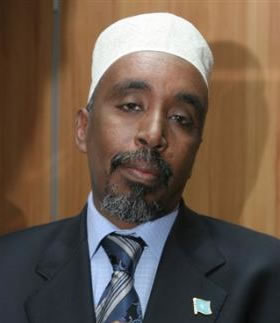 NAIROBI, Kenya - (AP) A top Somali politician with ties to leaders of Somalia's militant Muslim movement appealed for calm in his country Sunday and urged remnants of the routed Islamic militia to surrender and join a peace process to end 15 years of anarchy.
Sheik Sharif Hassan Aden, speaker of Somalia's transitional parliament, told The Associated Press that the time for fighting is over and that all Somalis should cooperate to restore stability.
He also dropped his opposition to having foreign peacekeepers in Somalia, calling on Somalis "to welcome, to hail, to respect, to accommodate them in a peaceful manner."
Aden has been a strong critic of Somalia's U.N.-backed interim government and is closely linked to leaders of the militant Council of Islamic Courts, who have scattered into the countryside and promised a guerrilla war after being defeated on the battlefield last week.
Aden said he was sure one of the movement's two top leaders, Sheik Sharif Sheik Ahmed, would listen to his appeal.
"What I know from him, he is a peaceful man and if I have an opportunity to reach him, I will convince him to join us, it is good for his people and good for the country," Aden said.
Because of Aden's influence and past association with the Islamic militants, his support is considered key to any peace and reconciliation process.
Somalia's government had struggled to survive since forming two years ago and was under attack by the Islamic militia when Ethiopia's military intervened Dec. 24 and turned the tide. But while government forces have now taken over most of southern Somalia, clan warlords have begun to reassert themselves and the leaders of the Islamic Courts remain in hiding.
On Saturday, the interim government indefinitely postponed plans to forcibly disarm the Somali capital, Mogadishu, as hundreds of protesters declared they would not give up their guns.
In Mogadishu, Somalia's capital, the prime minister has named a 10-member committee on national security and disarmament, Yusuf Mire Serare, a parliament member appointed to the panel, said Sunday. He said the group includes civic group members, clan elders and businessmen.
Somalia's last effective central government fell in 1991, when clan-based warlords overthrew military dictator Mohamed Siad Barre and then turned on each other.
Jendayi Frazer, the U.S. assistant secretary of state for Africa, has been shuttling around the region to build support for the government and to encourage nations to prove troops for an African Union peacekeeping force to stabilize Somalia.
"Some people would like the United States to lead on this issue," Frazer said. "I would prefer that we lead from behind, and what I mean by that is pushing the Somali people first, pushing the sub-region next and then mobilizing the resources of the international community."
Frazer said Somalia is important to the United States because of its location in the Horn of Africa, where the Red Sea opens into the Indian Ocean.
The U.S. also wants to make sure Islamic extremists do not take advantage of the chaos to establish a safe haven. Frazer has repeatedly said al-Qaida's East Africa cell, blamed for bombings of two U.S. embassies and a Kenyan resort hotel, infiltrated the Islamist movement in Somalia.
Aden thanked Frazer for her involvement and asked for greater U.S. involvement in Somalia.
"We want to reconcile with each other and we want the United States to create confidence between Somalis and to create trust between the United States and Somalis," he added.
Source: AP, Jan 07, 2007