Tuesday October 26, 2021
By Ahmed Mohamoud Ismail
Kenya’s leaders miscalculated twice. Their statesmanship require that they do not do it for the third time
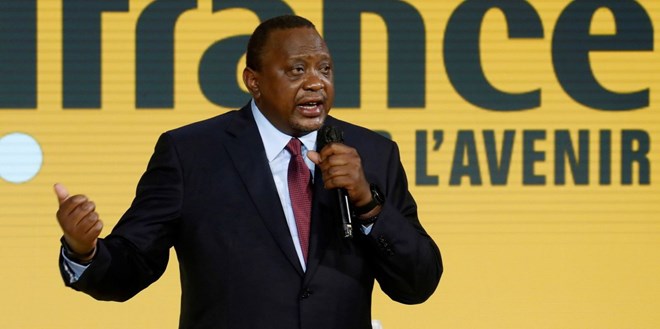
Drawing the line: Kenya's President Uhuru Kenyatta said the International Court of Justice had ‘neither jurisdiction nor competence’ to decide on the dispute Photo: AP/SCANPIX
Somalis were never confident that their interests could be protected by “their” government. The primary reasons for that are due to the apparent weakness of the Somali state compared to Kenya. Somalis reasonably believe that their government can be bullied or corrupted into an unfair agreement or is not sufficiently competent to negotiate a fair diplomatic deal. That is why they overwhelmingly supported the case going to the ICJ.
The bilateral relationship of the two countries has always been in Kenya’s favor. There are tens of thousands of Kenyans employed by the UN agencies and other NGOs serving the refugees as well as the refugees themselves. In addition, there are hundreds of millions of dollars of remittances from the Somali diaspora in support of the refugees, which is spent in Kenya every year, significantly contributing to Kenya’s economic activity and GDP growth. Kenya is a brotherly neighbor with whom we wish to have good relations, but if it chooses to mess it up just because we insisted on taking what belongs to us in a court of law, any resulting negative consequences will be primarily, but not solely, to Kenya’s detriment.
Finally, Kenya made a blunder when it underestimated the weak Somali state and, thus, pushed it to go to court and then tried to exploit such weakness to bully the Somalis into submission, and consequently galvanized the Somali public in support of the cause. I implore The Kenyan government not to make a third blunder. That third blunder will be if Kenya adopts a maximalist position of categorically rejecting the court’s ruling hoping that Somalia would negotiate a better deal than the court’s ruling, so much so that it leaves no room for itself to back down and accept “reality.” The reality is that the Kenyan government can accept the court’s ruling without significant political cost. After all, Kenya is not empty-handed, it got part of what it wanted, and the part that it did not get is due to the court’s judgement. Kenya can practice the law-abiding responsible world citizenship that it preaches. It is the right thing to do. The other part of the reality is that the Somali government is weak; its legitimacy in representing the Somali people is questionable. There is a consensus among the Somalis on this maritime issue. With good reason, they suspected that we were vulnerable to all the bullies in the neighborhood due to the weakness of our state. The court’s ruling now vindicates that suspicion. Under these circumstances, any Somali government that makes concessions on the court’s ruling would be committing political suicide. It is Kenya that is the stronger and more stable government, and it has sufficient political cover to accept the court’s ruling. I appeal to Kenya’s and Kenyatta’s better angels to do the right thing and accept the verdict.
Ahmed Mohamoud Ismail is a Professor of Accounting at SUNY Dutchess Community College in
Poughkeepsie, NY