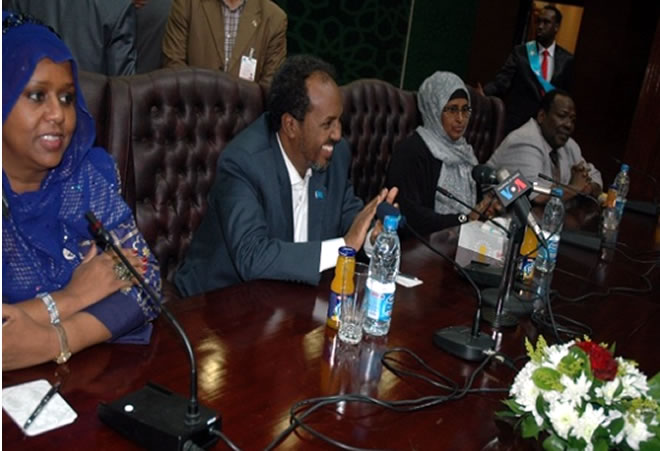
The Smiling President sitting comfortably between his wife (right) and his foreign minister, Fawzia Yusuf Haji Aden (left) at the Methodist Central Hall in Westminster
by Muuse Yuusuf
Saturday, February 09, 2013
In the past, welcome events for Somali presidents, such as the late President Abdullahi Yusuf’s visit to London, were much localised and exclusive, dominated by particular groups with narrow minded agendas and interests. Believe or not some of them were held at hotels or at some obscure small community centres often attended by presidents’ lineages and their sympathisers. Organisers of these events were very much concerned about presidents’ safety and security, as opposition groups were everywhere, lurking from every corner, waiting for any opportunity to ambush the visiting president and his entourage. In particular, I remember Abdullahi Yusuf’s visit in London at the height of the controversy over the Ethiopian invasion of Somalia, and how very angry Somalis surrounded his hotel, calling him names, and carrying placards with obscene and abusive messages. Obviously, this reflected the ugly face of the cut-throat politics at the time when Somalis were deeply divided among themselves over the invasion, and the late president was accused of being behind the invasion.
Former president Sheikh Sharif’s visit in London was less controversial and to some extent popular than Abdullahi Yusuf’s. This is again because of the prevailing political atmosphere of the time in which Somalis saw the president as a reconciling figure. The president was heading a government, which, unlike the previous TFG, had rejected violence to achieve political ends, and had accepted the principle of reconciliation and political negotiation. And the visit was after Ethiopians had been ejected from the country and the Somali people were feeling relieved and proud of their victory against their enemy. Wearing the Islamic turban, a symbol of piety and honesty in Somali culture that divides men into “waranle” (warrior) and “wadaad” (saint) and accompanied by Sharif Hassan, former speaker of the parliament who also wore a turban the two Sharifs were popular among those who attended the welcome events. They were seen as saviours.
Now let me return to President Hassan’s recent visit in London. Unlike the previous ones, the welcome event was held not only at the heart of London, but very close to the seat of the UK government. The House of Commons, the Big Ben, the 10 Downing Street and other government department buildings were all at a walking distance from the Methodist Central Hall in Westminster where the conference was held. By holding the event at this location it was probably meant to make it more inclusive and a public event in which any Somali who had the guts to endure a two-hour long queue in a freezing cold weather was welcomed to see their smiling president.
Organisers of the event were not disappointed, as up to 3,000 people congregated at the hall to see their president making an important political speech, highlighting his vision and the way forward for his country. The event was probably the biggest Somali political gathering held in London to honour a visiting Somali president. Looking back, probably neither Siyad Barre nor Abdullahi Yusuf nor Sheikh Sharif had ever enjoyed such a warm welcoming atmosphere. This again reveals the current prevailing mood of reconciliation among Somalis who are now proud of their full-fledging government that has been recognised by the international community. It also showed that after 20 years of civil wars, Somalis are now ready to forgive each other and forgot whatever happened in the past.