Mohamed Haji (Ingiriis)
Email: [email protected]
Saddex qeyb, aa loo dhigayee
Soomaali saddex qeyb, aa loo dhigayee
1. Qaar baa qaxayoo, qaxooti noqdee
2. Qaar baa la qaloo, la qoorgooyee
3. Qaar baa qadayoo, quud la’aan joogee
Qabyaaladdiyaa, khilaaf dhalisee
Qasaaro keentay, kheyrba nooma ahee
In layska qeybtaa, lagu qaboobaayee
Qiimaheen dhacayee, qarannimadii luntaye
Aan ka qeylinno, qurbeynu qubannahaye
- Saalim
The grave tragedy in Somalia presents indications of a new Holocaust, for it affects severely the most susceptible and indefensible group – women, children and the elderly – in the hands of ruthless groups competing for power and scarce resources with the grooming of external forces. Even though civil war has raged and afflicted
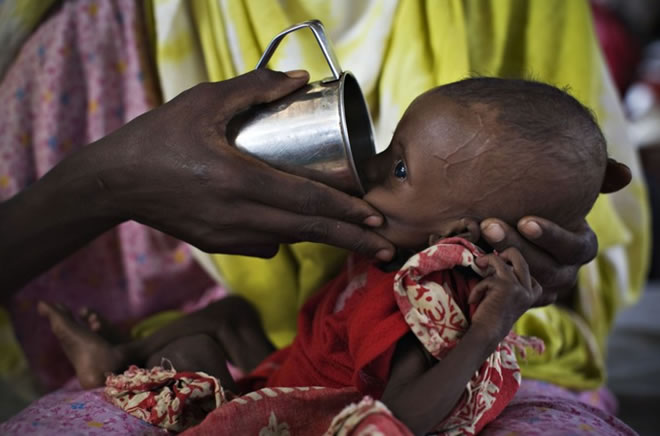
Gobsmacking in this situation is that the international community is now watching a human catastrophe more huge than Darfur’s, giving the Somalis a strong impression that they have been forgotten – in particular, at this critical juncture of their history when destitute women and children are dying on the Somali border with Kenya and Ethiopia for starvation in an attempt to flee from persistent bloodshed. Nor has the international community done much to prevent this humanitarian crisis. One crucial feature that the United Nations based to justify on December 1992 intervention was that obstruction of the delivery of food and medical supplies to recipients had constituted an extreme and appalling drought.
However, the extended drought plaguing the Somali population in the Horn of Africa, which the UN acknowledged as the world’s worst humanitarian disaster, is suggestive of how genocide is unfolding Somalia. The images of the drought – poverty, malnutrition and dehydration – are so disturbing to such extent they are gruelling to watch. It is reminiscent of Black Hawk Down movie, which depicted an American general incisively contending that the death of 300,000 innocent Somalis is not a civil war, but genocide.
In 1946, the General Assembly of the UN unanimously adopted that genocide is ‘a crime under international law, contrary to the support and designs of the United Nations, and condemned by the civilised world’. Having derived from this deliberation, the Genocide Convention in 1948, drafted soon after the Nuremberg Trial in
Professor Paola Gaeta who teaches International Criminal Law at
While several states stood accused of genocide in International Court of Justice (ICJ), there has been growing questions on how states could be held accountable for genocide. For instance, the ICJ found that ‘Serbia was not responsible for genocide, but only for failing to prevent the commission of genocide in Srebrenica and failing to punish its alleged perpetrators by not handing them over to the International Criminal Tribunal for the Yugoslavia’. Nonetheless, in one significant case, the ICJ tribunal agreed that ‘genocide’ meant the destruction of a substantial part of a group of people, which, in this context, can be applied to Somali women and children fleeing from a Janjaweedian type of terrorism.
Under the Genocide Convention, a state is responsible for genocide or any of the other acts listed in Article III where ‘a person or group whose acts are legally attributable to the state commits any of the acts proscribed by Article III of the Convention’. It is here that the need arises to establish that persons or groups acting on behalf of the State (or situations where there is no state institutions like
In retrospect, some states have attempted, at times successfully, to derail the process of gathering information on the implication of the crime. In relation to Darfur (Sudan), the UN Commission of Inquiry found that attacks against tribes could not be categorised as acts of genocide committed by Sudan, for the Commission was unable to find evidence of the genocidal intent of the supreme political authorities of the state, thus reaching a conclusion that there was ‘no proof of a plan or policy of genocide’.
Identical to that of
Irving Horowitz provides a fragmentary, yet sketchy distinction of genocide in his book Genocide: State Power and Mass Murder by defining it ‘as a structural and systematic destruction of innocent people by a state bureaucratic apparatus’. However, dealing with unique cases in conditions when states attest to be weak or collapsed and the stage is beset by hostile factions committing genocide in one form or another entails serious consideration.
Article 8 of the Genocide Convention also stipulates that countries may call on the UN to take action for the prevention and suppression of genocide. In his study, ‘Could the Rwandan genocide have been prevented?’, Dr. Gregory Stanton provides eight stages of genocide: 1. Classification, 2. Symbolisation, 3. Dehumanisation, 4. Organisation, 5. Polarisation, 6. Preparation, 7. Extermination, and 8. Denial. Taking his classification under a microscope, one may find that
For worse, labelling genocide as a Somali civil war, showing reticence and creating conceptual uncertainty appear to be debauchery on the part of international community. Stenson has documented that during the Rwandan genocide ‘refusal to name it genocide meant that policy makers in denial could continue to obstruct action because they could argue there was no imperative to intervene. [Even] lawyers misconstrued the law on the duty to intervene, arguing that the Genocide Convention creates a legal, rather than simply a moral duty to do so’. In sum up, failed states such as
In contextualising the case of Somalia, the primary perpetrators of the genocide eclipsed in drought are not merely al-Shabaab and its jihadist partners, but also those standing on the other side of an intersecting road – the so-called Transitional Federal Government, Ahlu-sunna Wal Jame’a and clannish mini states pursuing power and hard cash (on corrupt basis) at the expense of vanishing population. The main victims are emaciated women and children given the fact that, unlike Darfur, the genocide in Somalia has not received a great deal of attention, but should the international community declare that what is currently unfolding in Somalia is genocide – or acknowledging it, to say the least - would inevitably spur international response. If not, many more innocent Somalis are likely to die in this slow genocide.
Mohamed Haji (Ingiriis) is currently working on his Master’s degree (MSc) at the Faculty of Applied Social Sciences at