|
By Muuse Yuusuf
 |
This is your constituency to serve
|
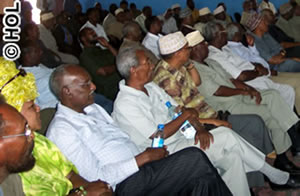
As the majority of Members of the Transitional Parliament (MTPs) meet in Baydhabo, a glimmer of hope and expectation fill in the hearts of many Somalis and their friends and supports from the international community. However, I am concerned that history will repeat itself, and that hopes will be dashed again as a consequence of the honourable MTPs failing to achieve any concrete results from the meeting, or the conference descending into chaos and a punch-up as it did in Kenya. I am particularly concerned that topics such the deployment of foreign troops, the lifting of the arms embargo, personal ambitions and self-interest, and the Mogadishu issue will dominate the meeting, and that the crucial issues of legitimacy, representation, constituency and leadership that are essential in nation-state building will be marginalised or forgotten. Recent events since the formation of the TFP (Transitional Federal Parliament) in Kenya show that the above four topics were the major factors that divided MTPs into the Speaker’s corner and the President’s camp. Also it is obvious from speeches made by politicians in Baydhabo and elsewhere that the topics have not gone away but are lurking around to surface later on in the meeting.
In this article I will argue that there would be no need for the deployment of a foreign army, the lifting of arms embargo and the need for a capital city, provided that MTPs take sincerely and seriously the crucial issues of legitimacy, representation, constituency and leadership at grass root level. Also, I will outline some challenges or a list of tasks that each MTP will be expected to complete before or at the end of the term of TFP. The tasks or challenges will be used as a benchmark for measuring up an MTP’s legitimacy, credibility, trustworthiness and integrity. Those MTPs who rise up to the challenges and complete their tasks before or at the end of the term will be considered as honourable real MPs and will be entered into the golden pages of the history. Those MTPs who do not measure up to the challenge will be dismissed as failed MTPs who do not possess the wisdom, the vision, the integrity, the dignity and the courage, that are essential for a hero to command trust, and credibility that are crucial for a leader to save a nation.
It is not disputed that MTPs were selected and not elected by the people, that is why I coined the term “MTP” and preferred over the phrase MP. This is because the term MP is conventionally applicable in situations where members of a parliament were elected by the people directly. I have also coined the phrase “s-elected” when describing the status of MTPs because the term combines “selection” and “election”, which would be appropriate in MTPs’ current position, which is between selection-election. This is because in some political circles particularly those who believe in the process, it is argued that some MTPs were selected by the traditional leaders “ugaasyo, duubyo, suldanno, malaaqyo” etc who in turn were supposedly elected by their clans and therefore are representatives of the people. Therefore this group believes that MTPs are elected members of a transitional parliament. In other political circles particularly those who see the current transitional parliament as a process argue that some of MTPs are merely individuals who put their names forward and were then s-elected for perceived personal qualities, skills, clan-hierarchy, and seniority etc, and therefore do not enjoy legitimacy and cannot be considered as real MPs. However, for the sake of argument and to make a point, and also as the huge debate surrounding democracy, direct elections, representation and legitimacy are beyond the sphere of a short article like this, let us assume that these MTPs were s-elected and because of this they “represent” some constituencies. Therefore the legitimate question that imposes itself is: who are their constituencies? And where are they? Although I do not believe in dividing up Somalis into clans, for the sake of argument let us again say that the constituencies of MTPs are their sub-clans who habitually reside in villages, towns, districts and cities across Somalia where they struggle to survive in a harsh environment with scarce resources but with dignity, resilience and courage. However until now, the “constituencies” are still waiting the service of MTPs who were “se-elected” for their personal qualities (e.g. courage, integrity, principal), expertise, and social status. Sub-clans or “constituencies” are still yearning for a hero, a leader who they can trust, who they can share with their dreams and fears, and a hero who has the wisdom, integrity and knowledge to solve some of their many problems.
 |
|
Since the formation of the Federal Transitional Parliament (FTP) in Kenya, some MTPs have been staying outside the country where they have been scrambling for a few hundreds of $$$ as their daily allowances, while others have been supported by their families or clansmen in abroad or at home. It is well documented that some MTPs were even thrown out of their hotels in Kenya after the $$$ from the international community run out and they were forced to live in an undignified manner. It is also well documented that few MTPs particularly government ministers have been traveling extensively around the globe. I bet you surf one of the many Somali internet sites, and hardly a day passes by without some news about a government minister in a foreign visit. Some of the sites have even dubbed the government as the “Dowladda-Dalxiiska-ku-Maqan” or the “Tourist Government in Exile.” Sometimes one wonders whether even some stable and functioning governments in Africa or Asia can afford to travel extensively as TFG ministers have done! On the other hand, some members had the courage and integrity to return to Somalia to engage with their “constituencies.” However, they tend to congregate in major cities or towns where in café bars they talk about the politics of the four topics mentioned earlier, as they plot to outwit other MTPs who they perceive as their opponents. The last group of the MTPs are those who are armed and have militias. It is clear from their behaviour that the main interest of this group is the preservation and protection of their power and position in the struggle for survival of the fittest!
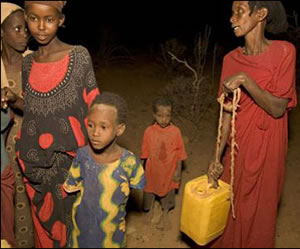
While MTPs have been scrambling for $$$, globe-trotting, plotting against each other, or congregating in major cities, the “constituencies” that they were s-elected to “represent” have been experiencing a harsher and harder realities ranging from natural and man-made disasters e.g. droughts, tsunami, civil wars, terrorists, and lack of basic needs etc. The life of a MTP in a Nairobi hotel subsidised by the international community is not comparable with the life of a barefooted nomad in a village who has no prospect of employment, and whose last she-camel was killed by the drought. But ironically, it is in the name of the barefooted poor nomad that the MTPs were s-elected in order to save them. During the selection process, it was perceived that some MTPs stood out of the crowd because of their vision, wisdom, courage, integrity, skills, social status, seniority and many other skills and qualities. It was also assumed or believed that an MTP would use their personal qualities and skills to serve the communities they were se-elected to “represent” and would gradually gain the trust and the confidence of their sub-clans. And yet so far and before the Baydhabo meeting most MTPs have been unable to bring themselves down from the undignified lives in hotels in Nairobi, or to stop bickering and squabbling among themselves thus failing to serve the nomad whose name is being used, as they failed to honour the oath they took to work towards the unity of the Somali people. The barefooted nomad, the misled and lost militia-men, the orphan and the widow at village, town, district, and at regional levels were/are left to deal with life’s challenges while MTPs sat in café bars, indulging themselves in a talk-shop about the above-mentioned four topics which, in my opinion, are insignificant if compared with the crucial issues of, representation, leadership and constituency that are crucial in nation-state building, but which, unfortunately, seem to be missing from their political debates and agendas.
The top-down level solution?
The issue of Mogadishu as capital city
It is not disputed the importance of a seat for a government or a parliament. However, in my humble opinion, all the arguments created by the “Mogadishu” as the capital city is not worth if weighted against the task that each MTP were supposedly “s-elected” for, namely to represent the interest of their “constituencies” in view of uniting all Somalis under a federal state. In my opinion it is at the grass root level namely at village, town, district, regional levels that the MTPs need to prove the personal qualities, political skills and expertise that they were s-elected for. Rather than wasting their time and energy at a one issue, it is at the grass root level where the MTPs should have been undertaking their constitutional responsibilities, e.g. demobilisation and disarmament, institution building, conflict resolution and reconciliation, protection of human rights and the environment, restoration of peace, and all other tasks that are summarised in Articles 68 and 71 of the Transitional Charter. In other words using their personal qualities and expertise, MTPs should be performing the above duties at local levels in order to first of all gain the confidence and the trust of the people they claim to represent, and then prepare their “constituencies” and themselves for a future direct election, in which the Somali people will hopefully decide a capital city for a federal Somalia. I know the civil war destroyed most of Somalis’ civic and economic institutions but I must say that it also made people realise that top-down solutions do not work, and that solutions are at lower levels. In other words the development of economic and civic institutions at villages, districts and regions is also crucial in nation-state building. For this reason, some communities have heavily invested in their own regions, and it is a de-facto that each existing regional state and administrations have their own capital cities. Cities like Boosaaso, Hargeysa, Garawe, Baydhabo, Kismayo etc are now becoming big towns, which will hopefully be rubbing shoulders with international cities and town soon. Furthermore, it is obvious that in post-state collapse era, in the eyes of many Somalis, Mogadishu is no longer the capital city and does not command the respect it once had as the official capital city of Somalia because of some atrocities committed, lack of safety and security, and the anarchy that prevails still now. Therefore, in my view, it is not wise to impose a capital city right now but to wait until such a time when people are ready and politically mature to choose a capital. However, the task of preparing people to choose a capital is on shoulders of MTPs who are in view shying away from their responsibility.
It is now clear that one of the reasons why the Arta Transitional Government (TG) failed was because it tried to use the top-down solution, i.e. the group thought that securing and centralising power in Mogadishu would bring in legitimacy and recognition. Also, most Somalis would agree that the military regime failed because of its obsession with a centralised state – in which Mogadishu or the Villa Somalia became the power house for all Somalis! Do the MTPs want to follow the road to failure?
It is understandable that MTPs need to have a focal-point or a place where they can meet to discuss their responsibilities under the transitional charter. However, in my opinion, MTPs could hold their regular and irregular conventions in any neutral town or a city as they are doing right now in Baydhabo until such a time when a city that is acceptable to all emerges. For example current MTPs should - through diplomacy - try to ask or negotiate with authorities in the North West state (Somaliland) or the Puntland State if they could hold a reconciliation meeting in Hargeysa or Garawe. This would be the second reconciliation meeting to be held in Somali soil to bring people together.
Page 1 | 2 Next
|