|
The following diagram shows how Somali pupils achieve higher grades in the early years of school (Key Stage 1) and then drop to the bottom of the scale in the last year of school (Key Stage 4). Can anyone explain why is that happening? There is, perhaps, something within the school that demoralize our children and lower their attitudes and ambitions towards learning.
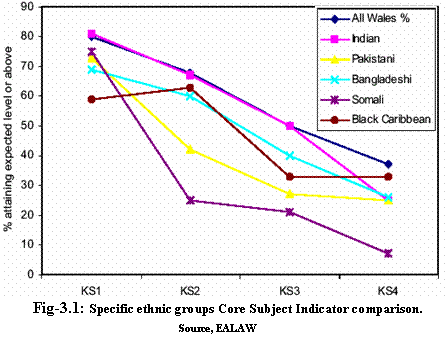
The chart clearly indicates that Somali children are underachieving in British schools, and so are the following excerpts:
There is some evidence that Somali children, previously resident in the Netherlands and Sweden are finding it difficult to settle in English schools and are underachieving. Qualifications and Curriculum Authority
Overall, the attainment for most groups is at least close to the LEA average, with Somali pupils being a notable exception (22% overall). Memorandum submitted by the Manchester Education Department to the House of Commons – 02/2003
And there was particular concern about Somali and Yemeni pupils whose performance was the lowest of all the ethnic groups in the survey. Cardiff - fair daily news digest - Wednesday 25 June 2003
There is an acute shortage of adult role models for Somali students in schools. Qualifications and Curriculum Authority
And in Canada!
“The bilingual Somali children are not literate, the ones that we have are not literate in their first language and after a year and a half they have a very, very low literacy level and they’re struggling so much that I don’t see them as helping new arrivals at all” (Primary school teacher, Ottawa, Canada)
The Somalians (sic) have limited writing skills, ….Somalians are a puzzling group as they are unlike any other immigrant group in the city” ( School Board Liaison Officer, Ottawa, Canada )Diana Masny, Faculty of Education, University of Ottawa.
And finally, in Denmark.
Immigrants and descendants have a much higher dropout rate than the population in average. Regarding immigrant inter-group differences, pupils with Polish, Pakistani, Vietnamese or Iranian background are doing best. Pupils with Somali or Lebanese background are doing worse. Danish National Focal Point 2002
So, what are the roots of the underachievement of our children?
1. Trauma – The civil war after-effects
Although it is true that the majority of the Somali children in the Western schools were born outside Somalia, some children may still be indirectly affected by the impact of the civil war through the behaviour of their parents or the adults they live with. Therefore, many of the children in British schools may not have experienced the actual war, but they still grew up in a long process of unsettlement which finally, brought them to this country. This is perhaps what makes some Somali children in British schools show signs of mental trauma as identified by a research commissioned by the United Nations to investigate the plight of the unaccompanied Somali children. In that research, Sheila Melzak, a psychiatrist working for Medical Foundation for Torture Victims in London told the researchers that Somali children “demonstrated a tendency towards aggression and violence in London schools” (IRIN 2003:51). She also stated that there were a relatively high proportion of Somali children in juvenile detention centres. The cultural gap between the children and their parents is one of the catalysts that might have contributed to such problems. It is believed that many parents have difficulty in understanding the social and health problems faced by their children. For instance, Melzak pointed out that the older generation tend to be dismissive of concepts of mental trauma and depression among children.
However, this might not always be the case as some teachers have low expectation of refugee children, and therefore stigmatise and label them with “learning difficulties” or “Behavioural Disorders”. If Somali boys show some tendency towards aggression as claimed by some researchers, it doesn’t necessarily show any relationship with the civil war in Somalia, it might be attributed to the overcrowded housing in which many Somali families live in.
2. Overcrowding
Many Somali families usually live in deprived neighbourhoods with overcrowded properties. The children who live in these properties have little or no space to organise their learning material. In addition to that, they don’t have enough time to use the learning resources e.g. the computer at home - if there is one at all. In fact in some homes there is one computer for all the family which is used by the parents to check their emails and listen to the BBC Somali service -sometimes 2 hours a day. This same computer is also used by all children to do their homework and play games).
Many psychologists state that one of the main environmental factors behind aggression is overcrowding. Furthermore, it is obvious when there are many people, including children, living in the same house that there will be a high noise level. Researchers also supports that there is evidence of a greater tendency towards aggression in condition of high noise levels
3. Racism
The Somali child happens to be a Muslim and Black, but these two characteristics do not necessarily ‘normalize’ them neither with other Muslims in UK who are predominately Asians as they do not share their colour, language, food or culture, nor with other black communities in UK who are different from the Somalis in terms of culture, religion and language despite the fact that most of the Somalis currently categorizing themselves as black Africans.
Despite the constant rhetoric about diversity and racial equality in the media and among educational professionals, what is undeniable is that teachers are a part of a wider community which, as every community, has cultural prejudices and racist attitudes. It is therefore possible to find racist attitudes among some of the teachers.
4. Language and Literacy
The language of instruction in the schools throughout Britain is English, therefore fluency in English is essential to succeeding in education. The Somali community in the UK speaks Somali language in their homes, community centres, parties and gatherings. The only time they usually speak English is when speaking to non-Somalis in the workplace, schools, colleges, doctor’s, etc.
Moreover, although Somalia was colonised by Britain, Italy and France, the Somali language remained the sole contender in the street communication and in education despite being an oral language before 1972 when a Somali script was adopted. In view of that, the idea of bilingualism is new to the Somalis. Even the Arabic language which is often referred as being the second language in Somalia is only spoken by those who either studied Arabic or have worked in the Arab countries. When parents cannot speak English their ability to assist their children in their studies will be limited. Not only that, but this might also diminish their will to visit the school and speak to the members of staff about their children.
As the pupils progress to the higher grades, their studies get more challenging and they need more fluent vocabulary and better writing and presentational skills. These skills are not necessarily learnt at school, instead pupils normally gain new language skills from their communication with parents, relatives and friends. It is here that the Somali children whose parents may have limited formal education and means of support are excluded by the system.
It is unclear to what extent some schools welcome asylum seeker pupils and acknowledge their needs. Many schools, with considerable number of Somali pupils, do not translate their policies to Somali language. What makes this more demanding is the fact that many Somali parents do not speak English and the only language they speak is the Somali language. These parents undoubtedly want to support their children, however, when they do not know their limitations and what the school wants them to do, they have little chance to help their children or understand their needs.
Education and learning is not confined to schools. Children learn from various sources including their families, communities, media and the wider environment. The following diagram illustrates how parents, schools and communities are uniformly interconnected and subsequently influence the children’s education.
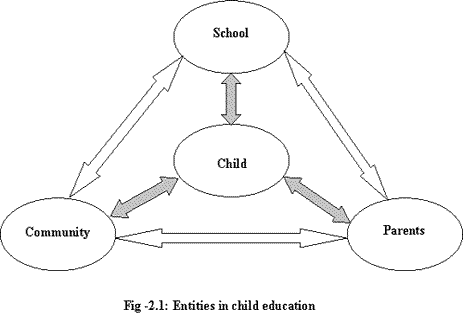
What is clear is that both schools and Somali parents are not doing their best to communicate to the other party. Unfortunately, many Somali parents have language problems and that makes them shy away from communicating proactively with schools. Nevertheless, it is hard to understand what prevents schools from reaching out to the parents. Perhaps the Somali community organisations have a role to play as the liaison between the schools and parents.
Similarly, parents, themselves need to raise their literacy to understand how the educational system in Britain works. For instance, there concerns about the lack of reading culture among the Somali community. It is believed that when parents read and own some books or literature at home, their children will learn to love reading and ‘grow with books’. Similarly when parents visit the local library regularly, their children will also learn to go to the library. Even those parents who do not speak English can look for any literature in Somali or in any other language they can read.
Another important player in raising the achievement of Somali pupils are the community organisations. Some of these organisations are funded by various authorities to execute educational programmes for Somali children. Moreover, these organisations are the ‘official’ gateway between the Somali community and other local or national authorities. Below are few points that these organisations could help coordinate to improve the achievement levels of Somali pupils.
-
Organising educational events to give confidence to children. For example they can give awards to those Somali children who got good marks in their tests. This will encourage other children to take their studies more seriously.
-
Publishing information in Somali language. As we said earlier, many parents do not understand English; it would therefore be helpful if Somali community organisations make some information available in Somali language.
-
Liaison between schools and the Somali community.
To conclude, it seems to be undeniable to accept that our children are not getting enough support in their education and are hence underachieving. Their future seems to be doomed if we do not wakeup in time and struggle to raise the achievement of our children. If not, we are undoubtedly sitting on a ticking bomb. It’s also obvious that those Somali children who get good grades are swimming against the tide because they are competing with other children who have countless resources in their disposal. The reasons behind the underachievement could be summarised as follows:
-
Lack of parental support : many parents are unable to offer help to their children. Many parents have never been to formal education, others simply do not know what they are supposed to do in order to support their children as they do not have any information regarding how the school system works.
-
Social deprivation : many families claim benefits and are housed by the local authorities. They cannot therefore afford to provide learning resources to their children.
-
Racism : although this study did not find racism in particular, to be a cause for the underachievement of Somali pupils, there are many researches that verify the existence of racism in some schools and its relation to the underachievement.
-
Invisibility : there is no enough attention to investigate the problems facing the Somali community in general, or the underachievement of their children in particular. It is also hard to find data about the Somali community as they are not often categorised as a separate ethnic group.
-
Labelling and stereotypes : some teachers often label Somali pupils unfairly as having aggressive behaviour or post-traumatic disorder as a result of their experiences in the civil war.
-
Unwelcoming classroom environments: some Somali pupils who may never have been to school arrive in UK during the school term and are usually placed according to their age. Their classmates are obviously in a favourable position as they have been studying several years and have laid their educational foundations firmly.
-
Lack of role models: Many Somali adults are not role models for the youth. Many educated adults found themselves in an unfortunate position after the qualifications they gained outside UK and their previous experiences were not recognised by the employers. When some children see their parents in such a situation, they may doubt the benefits of going to school.
The Guardian, Muslim burial honoured, June 23, 2004.
United Nations, Office for the Coordination of humanitarian Affairs, 2003, Gap in Their Hearts, the Experience of Separated Somali Children, Nairobi, IRIN.
Malim, T and Birch, A, (1998), Introductory Psychology, Basingstoke, Palgrave.
Donnerstain and Wilson (1976) in Malim, T and Birch, A, (1998), Introductory Psychology, Basingstoke, Palgrave
Abdul Diriye,
London, UK.
[email protected]
| The opinions contained in this article are solely those of the writer, and in no way, form or shape represent the editorial opinions of "Hiiraan Online" |
|