
Monday December 8, 2025
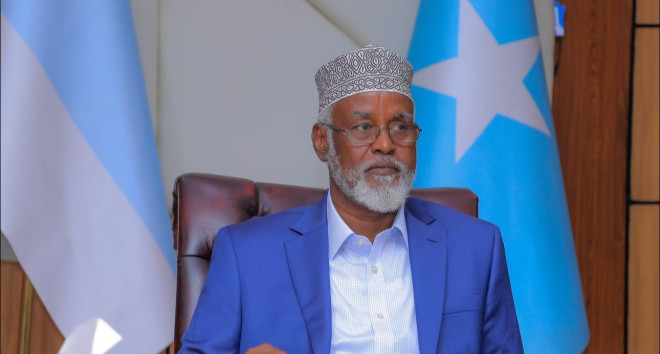
Kismayo (HOL) — Jubaland President Ahmed Mohamed Islam ‘Madobe’ has created a seven-member committee to coordinate the state’s response to a deepening drought that has left communities across southern Somalia facing severe shortages of food and water, according to an official decree released Sunday.
The presidential order states that the drought has caused extensive harm to people and livestock, prompting the regional government to form an interministerial body with the authority to organize relief operations and accelerate aid delivery. The committee will be chaired by the Minister of Humanitarian Affairs and Disaster Management.
Other members include the ministers of interior, energy and water, livestock and rangeland, health, women and family affairs, and youth and sports. Together, they are tasked with assessing urgent needs, coordinating with humanitarian partners and directing assistance to the hardest-hit districts.
Nearly all districts in Jubaland are affected by persistent drought conditions, with Kismayo, Badhaadhe, Ceel Waaq, Bua’ale, Afmadow and Garbahaarey among the hardest hit, according to humanitarian partners. In Gedo region, an estimated 33,496 households, about 200,000 people, in Baardheere, Luuq, Belet Xaawo, Ceel Waaq, Doolow, Garbahaarey and Buurdhuubo are facing critical water shortages as boreholes, shallow wells and water pans dry up, and the price of a 200-litre barrel of water has risen to US$6 from about US$2.50 in some areas.
Across Jubaland, aid agencies report mounting pressure on water points and pastoral livelihoods. Authorities say communities are confronting rising health and livelihood challenges linked to scarce and costly water, deteriorating pasture and loss of income from weakened livestock. Partners have recorded new displacement as families leave dry rural areas for towns such as Afmadow and Dhobley, while ongoing armed conflict has already driven about 4,000 families from Jamame district in Lower Juba, further straining local services and markets.
Despite limited resources, some relief operations are underway. In Ceel Waaq district in Gedo, Jubaland authorities, working with the King Salman Humanitarian Aid and Relief Centre and a national partner, recently distributed food assistance to 1,000 displaced families. In the Kismayo area, an international partner is constructing two water dams in Qandal and Fuma to improve access to water and strengthen resilience for about 1,600 households, according to the OCHA report.
The announcement of the drought committee comes as Jubaland remains locked in a deep political dispute with Somalia’s federal government. The region has asserted that it now operates as an independent government rather than a federal member state, following constitutional amendments that removed all references to federal status.
The shift intensified a confrontation that escalated after Jubaland extended presidential term limits in 2024 and re-elected Madobe in a vote that Mogadishu declared unconstitutional. The standoff has included competing arrest warrants, armed clashes between federal and regional forces in border districts, and regional mediation efforts led by Kenya. Jubaland’s move mirrors wider national tensions as Somalia struggles with an unresolved constitutional crisis and widening divisions among federal member states.
Madobe said the government must act quickly to limit the impact of failed rains that have disrupted livelihoods across Jubaland. He urged the committee to operate with transparency and efficiency, warning that delays could deepen the crisis for vulnerable families already struggling with water scarcity and livestock losses.
The drought follows several seasons of below-average rainfall that have weakened food security across the region. Nationally, at least 4.4 million people, more than one-fifth of Somalia’s population, are projected to face high levels of acute food insecurity between October and December 2025, and an estimated 1.85 million children under 5 are expected to suffer acute malnutrition through July 2026, according to the latest IPC analysis cited by OCHA. The UN Emergency Relief Coordinator has allocated US$10 million from the Central Emergency Response Fund for drought early action in Somalia, targeting more than 603,000 people, but the 2025 Humanitarian Needs and Response Plan is only 23.7 per cent funded.
Aid groups have reported rising displacement and growing concerns about malnutrition, particularly in rural areas reliant on livestock herding and small-scale farming.
Jubaland officials say the newly formed body will serve as the central command for drought response planning and coordination, ensuring that state agencies and international organizations can direct resources where they are most needed as conditions continue to deteriorate.