
Tuesday January 22, 2019
BY MICHAEL HARARI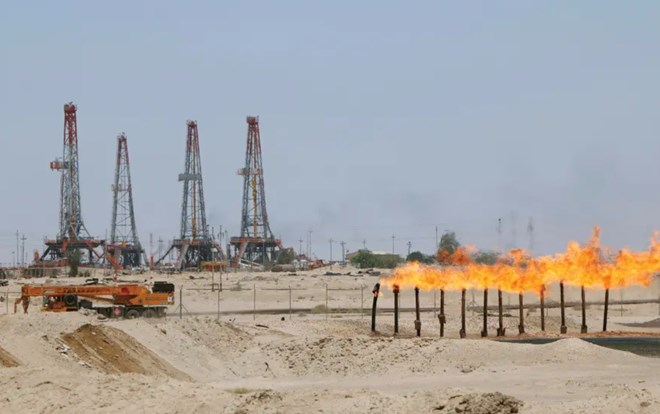
Egyptian and Israeli interests converge when it comes to the energy sector.. (photo credit: REUTERS)
The mid-January regional meeting in Cairo, during which a new regional gas forum was announced by seven eastern Mediterranean countries, illustrates the promising political potential embedded in the discovery of natural gas reservoirs in the Mediterranean. No less, it reflects the close relations between Israel and Egypt.
Israel and Egypt have maintained close political and security ties at the highest level in recent years, which remain covert for the most part. In a rare move, Egyptian President Abdel Fattah Sisi revealed it in January an interview to the American program 60 Minutes, referring to the close cooperation with Israel, including joint military efforts against Islamic State in the Sinai Peninsula.
The current convergence of interests between Israel and Egypt comprises several layers that result from the dramatic developments in the Middle East in recent years: the turmoil during and after the Arab Spring; the regional threat posed by Iran, especially to the pragmatic Sunni states; terrorist activities in Sinai (that require Israeli-Egyptian cooperation, including a reassessment of the security annex to their peace agreement); and the Hamas control over the Gaza Strip. In addition, the Egyptian regime and military are still traumatized by the Muslim Brotherhood rule, which was in place from the ousting of Mubarak until the overthrow of Morsi. This further explains the joint Israeli-Egyptian efforts to defy the threat posed by fundamentalist Islamic movements, including Hamas in the Gaza Strip.
The warm ties described above should suffice to complete and implement these agreements signed by companies in the private sector. The level of trust between the Israeli and Egyptian governments is high, as exemplified by the recent visit to Cairo by Israeli Minister of Energy Yuval Steinitz. Moreover, the gas forum that convened in Egypt, with participation of energy ministers from Greece, Cyprus, Italy, Jordan, the Palestinian Authority, Israel and Egypt, illustrates the new international geometry that is emerging in the eastern Mediterranean. The existing tripartite alliances – Israel-Greece-Cyprus and Egypt-Greece-Cyprus – are now joined by a new tripartite alliance – Jordan-Greece-Cyprus, and by the newly established Eastern Mediterranean Gas Forum. The existing and emerging alliances may expand and include additional countries, and the informal existing cooperation might institutionalize. Such developments would add positive Mediterranean dimensions to the complex dynamics in the region.
Turkey, an important regional player, is currently absent from these various geometric settings. The countries that are currently cooperating in the eastern Mediterranean share an anti-Turkish agenda – Egypt, Cyprus and Greece (each to a different extent), and Israel – whose relations with Erdogan lack trust and are characterized by harsh rhetoric, despite the realistic potential for Turkish-Israeli cooperation in the gas sector. The chances to realize this potential were one of the catalysts to the signing in 2016 of the Israel-Turkey reconciliation agreement. Since, and following new crises between the two countries, these chances have steadily diminished.
Will Israel and Egypt be able to translate their warm ties and convergence of interests into formal energy agreements at state-level? The motivation for them to do so is clear. However, the Egypt public still opposes any normalization of ties with Israel. After all, even during the Mubarak regime, the Egyptians did not welcome economic and socio-cultural cooperation between the two countries, despite the beneficial cooperation that took place around the joint industrial zones. The launching of a viable Israeli-Palestinian peace process will clearly help to improve this situation. It will create a more positive atmosphere in the region and above all a more favorable Arab public opinion. It can be assumed that the Sisi regime will succeed in overcoming domestic opposition. After all, energy cooperation between Israel and Egypt serves the interests of both countries, and perhaps Egypt will follow Jordan, who already formalized its energy cooperation with Israel, despite negative public attitudes in Jordan toward it.
The discovery of natural gas reservoirs in the eastern Mediterranean creates an exceptional convergence of interests between a number of countries in the region, including Israel and its Arab neighbors. This opens up a wide range of additional areas of cooperation, placing the Eastern Mediterranean on the “global map.” The visit of Steinitz to Cairo and the unique regional gas forum launched there may symbolize a significant step toward realizing the potential embedded in this region.
The writer is a policy fellow at Mitvim – The Israeli Institute for Regional Foreign Policies. He served as the Israeli Ambassador to Cyprus from 2010 to 2015.