
Friday November 25, 2016
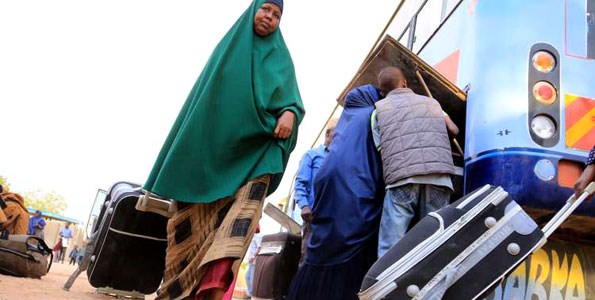
Refugees board buses for Somalia at Dadaab camp after the Kenya government announced plans to close the camp. PHOTO | JEFF ANGOTE | NATION MEDIA GROUP
On entering Hagadera, one of the five refugee camps in Kenya’s Dadaab complex, the message that greets you reads, “Return is my choice.”
This message, written boldly in English and Somali, is supposed to encourage more than 270,000 refugees to take advantage of the ongoing voluntary repatriation launched in 2013 and return to Somalia.
The atmosphere is tense as the countdown to Kenyan government’s the deadline, which has been extended from November 30 by six month, continues.
Interior Minister Joseph Nkaissery, while announcing the extension of the deadline from November 30 to the end of May next year, said the extension is due into the ongoing elections in Somalia.
Some refugees who had voluntarily returned to Somalia but slipped back to Dadaab due to insecurity and lack of facilities in their home regions, told The EastAfrican that they had volunteered because they believed that the Kenya government would arbitrarily return them to Somalia without taking into account where they hail from.
The voluntary repatriation programme has been slowed by the Somalia government’s lack of resources to provide basic facilities such as shelter, livelihood, health and security. UNHCR recently appealed for $485 million to settle the refugees inside Somalia.
Young men gather in groups unsure of their future as the security situation in Somalia still remains fragile.
“I was born here and I don’t know anything about Somalia where they are telling us to relocate,” said Mohammed Absame, a 17-year-old born of a refugee mother and a Kenyan father.
A number of human-rights organisations working in the region and beyond are opposed to the closure of Dadaab camp, while the Kenya government says it is a recruitment ground for the Al Shabaab elements that attack Kenya.
Security situation
Hassan Nur, the United Nations High Commission for Refugees chief security adviser says the security situation in Dadaab remains stable since Al Shabaab have not carried out any attacks in recent months, although it remains unpredictable because of the porous borders.
The Somalia border is only eight kilometres away but the Kenyan security forces have no capacity to patrol its entire length.
The refugees say their biggest fear is harassment by the Kenyan security forces meant to force them out, but the Kenya government insists that the return is voluntary and nobody will be repatriated against their will. Early this month, five young men from Kambioos Camp were arrested for riding in a vehicle with Somalia number plate but locals say that is a common feature in Dadaab. Some refugees have also been arrested for cutting down trees for fuel.