
Monday February 1, 2016
By ELIUD OWALO
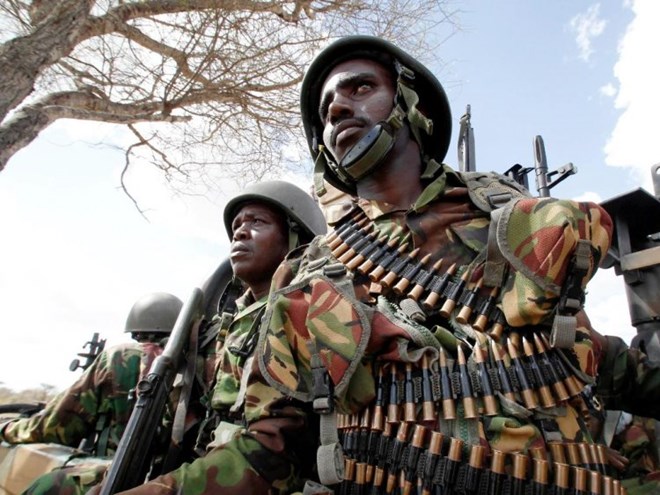
focused: Kenya Defence Force soldiers patrol Tabda village, 80km from the Kenya-Somalia border, on February 20, 2012.
The Kenya Defence Forces rolled into Somalia in 2011 and were later absorbed into the framework of the African Union Mission to Somalia. The core objectives of Amisom are threefold: First, decapitate and degrade al Shabaab’s ability to launch attacks from across the border; Second, create the right environment for the establishment of a proper functioning government and governance institutions, including security agencies, in Somalia, and; Third, provide space for the provision of humanitarian assistance and start the process of state and livelihoods reconstruction.
To inform the approval decision, Parliament would have been provided with a detailed plan, clear benchmarks to be attained and specific timelines set before KDF was sent to Somalia.
The plan would also have provided a clear monitoring, evaluation and reporting framework with clear performance indicators, and a results matrix. There should also have been an elaborate risk management strategy, with commensurate proactive mitigation measures. Astonishingly, to date there has never been a comprehensive situational audit and analysis report on the Kenyan military activities and achievements in Somalia, if any, presented to Parliament.
In the wake of the terrible attack and death of Kenyan military personnel in El Adde, Somalia there is need to institute thorough investigations. Parliament should conduct an independent inquiry into Kenyan military presence in Somalia and make specific recommendations. The military leadership should take these two issues very seriously. Is there an enemy within the military? How can such an attack happen? There must be something that went terribly wrong. Hard questions must be asked and answers provided to Parliament on military command and control, operations strategy and intelligence gathering. An independent professional panel must also be constituted to review and assesses military structures, leadership, resourcing, capabilities and capacity.
Second, a country cannot have its military engaged in war without providing a comprehensive audit status to the citizens.
There has to be a feasible cost-benefit analysis and plausible exit strategy to avoid endless entanglement, because the Kenya military is not an occupier force. It is against this background that there is need for the establishment of a parliamentary select committee to inquire into not only the deployment of our security forces in Somalia but also the internal threats we have faced in the last three years, including but not limited to KDF's response to such internal threats such as the Westgate Mall and Mandera University College terror attacks.
The writer is a management consultant based in Nairobi.