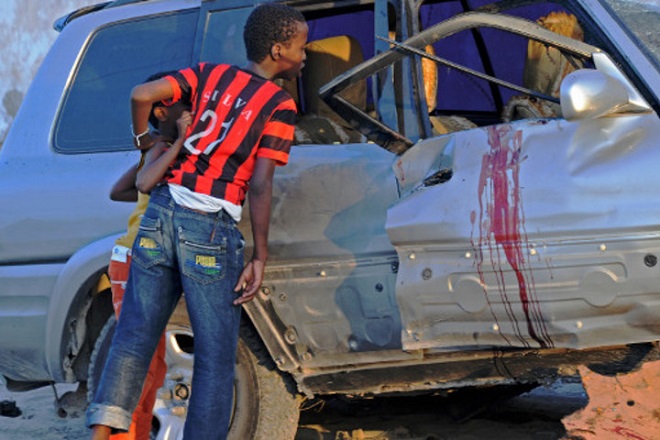
Children examine the remains of a vehicle which blew up in Mogadishu November 27th, killing an engineer. Somali media organisations have pledged to work together to safeguard youth from the violent ideology that spurs this type of crime. [Mohamed Abdiwahab/AFP]

By Shukri Mohamed
Thursday, December 4, 2014
advertisements
MOGADISHU — Many young Somalis join al-Shabaab because they lack awareness about the dangers of the group and its misguided ideology, Somali media agencies said at a conference in Mogadishu last week where they pledged to make a concerted effort to counter extremist views.During a day-long conference November 23rd organised by the National Union of Somali Journalists (NUSOJ), the Somali Independent Media Houses Association (SIMHA) and the Centre for Community Awareness (CCA), media, civil society and government representatives discussed how journalists can help stop the spread of violent ideologies and lay the foundation for reconciliation in Somalia.
"As we know, extremism is spreading in our country, especially among the youth," said CCA director Mohamed Ibrahim Ali. "Therefore, we want to fight against al-Shabaab, al-Qaeda and any group that is against Somali governance."
"Extremism in Somalia has destroyed our society," he told Sabahi. "It has killed academics, intellectuals and anyone who would have benefitted this society. Therefore, we recognise that extremist ideology is the enemy of the nation, the people and the religion."
The conference sought to gather opinions from the participants on ways to address extremism and also to strengthen awareness on these issues, Ali said.
"The most important goal was to come up with a strategy to fight extremism and violent ideologies and also to achieve real change based on promoting peace and co-existence," he said. "We agreed that all that can be achieved through the media, and that is why we chose to promote awareness within the media agencies."
If many young Somalis have joined al-Shabaab, al-Qaeda or the Islamic State of Iraq and the Levant (ISIL) it is in part due to the media's failures to debunk these groups' ideologies and engage the public to raise awareness, Ali said.
That is why media professionals have now decided to take a more active role in the fight against extremism, he said.
Media is driving force in free society
"Each country that has made progress started its progress through the media," Ali said, adding that there will be further conferences and training sessions for journalists and also for Somali youth. "We have realised that we can easily reach every Somali person through the media."
SIMHA chairperson Hassan Ali Gesey said his organisation, a confederation of 32 news agencies, welcomes efforts to strengthen the role of the media in the fight against terrorism.
The biggest threat is from al-Shabaab and al-Qaeda, he said, noting that some media outlets broadcast direct statements issued by the leaders of these groups.
"What we want is to see an end to the exaggeration of the damage caused by terrorists," Gesey told Sabahi. "On the other hand, we want to see promotion and reporting of the progress taking place in reconstruction and peace."
"We will hold trainings to strengthen the role of the youth and the media in the country's reconstruction," he said.
During the conference, media representatives agreed to not give extremists a platform to disseminate their distorted ideologies, debunk al-Shabaab's misleading reports, and promote peace and reconstruction, Gesey said.
"There is a lot of fear within the media, but understanding the reality of what is at stake is a good starting point," he said.
"The extremists have already sentenced all of us [journalists] to death, but let us not wait to be killed," he said. "Let us be bold and promote the fight against extremism."
A united front against extremism
Independent journalist Abukar Mohamed said that to sustain progress it is critical for the media to stand united against anything that threatens Somalia's future.
"[Such unity] would result in the media not reporting things that can destabilise society such as messages sent by the people who are promoting enmity and extremism and those who are threatening to kill and destroy," Mohamed told Sabahi. "Elders, clerics, women and various sectors of the community should also take part in these efforts."
To combat extremism, the issues surrounding youth unemployment also should be addressed, Mohamed said, as there is widespread injustice in hiring practices.
"In government agencies, hiring depends on whether one knows the person in charge of that agency. The person closest to him gets the job and there is no justice," he said. "That could encourage the person who was denied the job to join extremists or otherwise participate in [activities] to cause mayhem at the agency that rejected him."
Extremism is not limited to groups such as al-Shabaab and al-Qaeda, said Liban Abdi Ali, a journalist with US-based Alhurra TV, as it also can be related to regionalism and tribalism.
"Attention should be paid to the people who are devoted to a clan or region, and who choose that over the greater good of the nation," he told Sabahi. "Some of our recommendations include educating the youth against all those issues, especially issues related to religious extremism."
Liban called on his fellow journalists to work for the sake of Somalia's development, saying the role of the media is particularly critical at this point in the country's history.