Deutsche Welle
Thursday, July 11, 2013
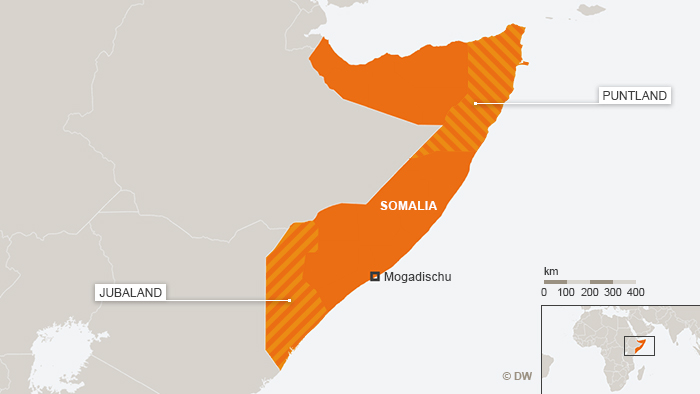
Somalia has had a legitimate government since 2012 and although Islamist insurgents are still active, it is relatively stable. But there is tension between Mogadishu and semi-autonomous regions such as Puntland.
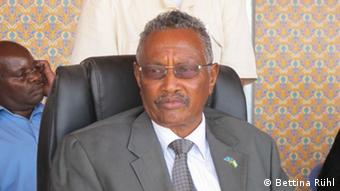 President Abdirahman Mohamed Farole accuses Mogadishu of violating the constitution
|
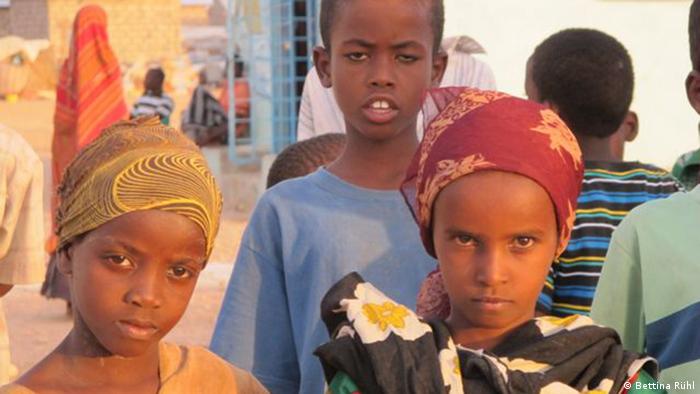
The mood in Garowe, capital of Somalia's semi-autonomous region of Puntland, was festive. The crowd had tensely awaited the arrival of leading public dignitaries including the President Abdirahman Mohamed Farole, who delivered a speech. The ceremony was held to mark the completion of 1,200 new dwellings for displaced persons which were built by an international aid organization. Thousands of refugees from war-torn southern Somalia have sought sanctuary in Puntland.
President Farole arrived punctually. He said a few words of thanks to the aid organization and the donors and then promptly changed the subject. The government in the Somalia capital of Mogadishu was violating the constitution, he maintained. They had been agreement over the creation of a Somalian federal state, but Mogadishu was preventing development in the regions within that federal framework. If Mogadishu did not mend its ways, then the conflict in the country would persist. The president then departed the scene as abruptly as he had arrived.
Interpreting the constitution
Civil war broke out in Somalia in 1991 and in parts of the country it is being waged to this day. In the
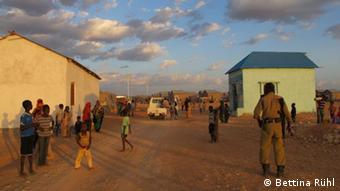 New housing in Garowe for refugees who fled the fighting in southern Somalia
|
The authorities in Puntland maintain that Somalia's constitution envisages the creation of new republics within the federal framework. Mogadishu insists that the opposite is true, namely that the constitution puts priority on a strong central government.
Cedric Barnes from the International Crisis Group says both sides are in the right under the present provisional constitution. "This problem arose because a number of key questions were left unresolved while the Somali government was being formed," he said. "We are now paying the price for this and the central government and the autonomous regions will now have to sort out the issue," Barnes added.
The problem is becoming acute in the south of the country. In 2011, Jubaland formed its own autonomous authority, roughly modelled on Puntland. Jubaland, which borders on Kenya, was previously controlled by Islamists. Mogadishu disputes Jubaland's autonomous status..
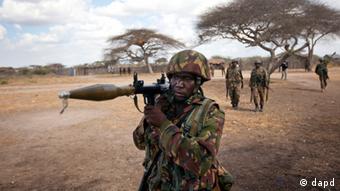 Kenya is heavily involved in fighting the Islamist insurgency in Somalia
|
But the conflict over Jubaland and its key port city of Kismayo doesn't end there. The coastal region, which looks out on to the Indian Ocean, has been one of East Africa's trouble spots for years. Following the expulsion of the Islamist militants al-Shabab, Ahmed Adobe, a former Islamist governor of Kismayo, has declared himself president of Jubaland.
Rivalry between clans