By JERÉ LONGMAN
Saturday, August 11, 2012
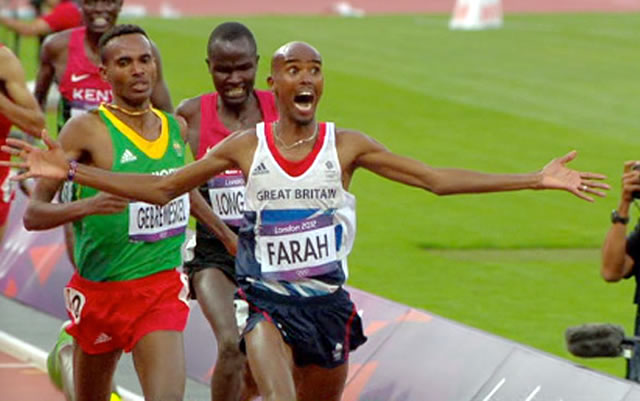
When he reached the end Saturday, in 13 minutes 41.66 seconds, Farah slapped his shaved head in celebration and performed a few situps, as if he still had plenty of energy after hammering the last lap in 52.94 seconds.This was the slowest Olympic 5,000 final since the 1968 Mexico City Games, but that hardly mattered to Farah. He joined celebrated names like Emil Zatopek of Czechoslovakia, Lasse Viren of Finland and Kenenisa Bekele of Ethiopia among men who have won the 5,000 and 10,000 meters at the same Olympics.
“There is no way to describe it,” said Farah, 29, who moved to Britain from Somalia when he was 8. “As a young athlete, you dream of becoming Olympic champion. To do it twice is unbelievable.”In the women’s 800 meters, Mariya Savinova of Russia won in 1:56.19, and Caster Semenya of South Africa closed furiously to take the silver in 1:57.23. Semenya was last midway through the race and seemed to wait too late to make her charge.
Her start appeared to be a tactical mistake, but the finish seemed to confirm the great resolve of an athlete who had been subjected to sex-verification tests in 2009 and withering personal scrutiny as track officials clumsily handled the matter of whether she should be allowed to compete as a woman.
“I feel very proud,” Semenya, 21, said.
Last Saturday, Farah won the 10,000 meters while his American training partner, Galen Rupp, took second with their patient sit-and-kick approach. Many expected the Ethiopians and Kenyans to open the 5,000 with a fast pace or throw in a fierce charge with three or four laps remaining to attempt to nullify Farah’s kick.
Instead, the race opened at a jog, with a 70.6-second first lap. For much of the way over 12 ½ laps, it would be a slow, tactical race. Farah went to the back early and bided his time, moving up eventually to fifth or sixth place with four laps remaining.
“It suited me well,” Farah said.
His coach, Alberto Salazar, had told Farah to expect the East Africans to surge at that point. The Ethiopians did, but Farah remained calm. With 700 meters left, he moved to the front and began his long drive to the finish. Rupp came up on Farah’s shoulder. It was a kind of blockade strategy to force other runners to expend energy to try to get around them.
“It was a good race, but we made mistakes,” said Dejen Gebremeskel of Ethiopia, who finished second in 13:41.98. “We planned to make the race fast, but we didn’t do that. At the end, it was too late by then. We didn’t manage to reduce the number of athletes” in the lead group heading into the final lap.
Farah ran the final mile in four minutes. Rupp, 26, could not sustain the pace and faded to seventh, in 13:45.04, emotionally drained after the 10,000.