
by Angela Hatton
Friday, August 27, 2010
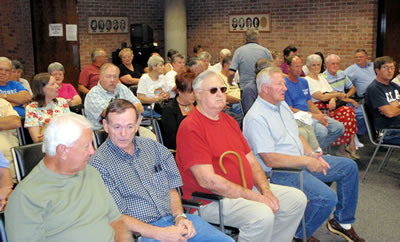 Attendants at the Zoning Board meeting |
A hundred people cram the Mayfield council chambers for the zoning board meeting. More wait in the atrium, and out on the streets in front of city hall. Sprinkled throughout the audience are a few folks in t-shirts that say "I'm an American, I believe in the Christian Church." Three police officers stand at the back of the room to prevent anyone from barging in. Zoning Board chair Austin Copeland begins the meeting with a directive.
"We don't wanna discuss religion, that's not what we're here for."
advertisements
This meeting is a redo. Earlier in August, the zoning board approved the conditional use permit, but they didn't allow a public comment section, and that vote was nullified. Florist Dick Conner, whose business is next door to the building the Somali Muslims rent, is the first to speak. "The people are the best neighbors I've had. I don't want to keep them from worshipping, wherever that is. Just so it's not there."
Conner cites limited parking as his main concern. The tri-plex building the Somalis rent has only six spaces. There are around 180 Somali Muslims living in Mayfield, according to their own estimates, though other reports have put that number high and lower. Pam Frizzell of New Wave Hair Salon, which borders the other side of the building, is also concerned about places to park.
"You take eleven real busy women working on two women at a time, you're talking twenty cars right there, not counting our cars that are in the back."
Frizzell adds that Muslims from outside Mayfield have expressed interest in worshiping at the mosque, likely increasing the number of attendees. Other concerns include no traffic controls or crossing sections in front of the building. A man who lives a few blocks away says the sound of the call to prayer early in the morning and late at night might violate city ordinance. Board member Don Costello asks to question the petitioner, but he's not in the council chambers. After a moment of confusion, the Graves County Sheriff talks privately with Costello.
"OK, we did find out, one of the representatives, the petitioner did show up. Um, because of the crowd out there, they turned them not knowing they were petitioner and should have been here. So Sheriff Davis is going to send somebody to retrieve them. Because it's only fair that they have an opportunity."
The searchers come back empty handed. When Costello motions that the meeting recess until the petitioner is located, the audience rebels. Again, Pam Frizzell.
Would you do that if I was late?'
Well we turned them away. According to Sheriff Davis, we turned them away.'
I got here early.'
Aaauhm.'
So did we.'
I know, I'm just saying, we're waiting. Would you wait for us?'
We have.'
Several say, No.'
Kentucky ACLU Executive Director Michael Aldridge says the city was right to hold the second meeting.
"Well it does appear that the board followed proper procedure in trying to get public comment and stating the parameters of the meeting, but it was unfortunate that the petitioner was turned away without the opportunity to present the other side. I think that would be the major flaw I saw with the meeting itself."
Also, Aldridge calls some of the public comments made troubling. One man who did not give his name warned than Islam is "more than a religion."
"So many of us have some different views but we're not trying to advocate any form of government. Historically, Islam does."
It was the only comment to incite applause. The audience applauded again when the board denied the permit. Board members made the motion on a section of state zoning statute 100, which states that the proposed site cannot violate the public safety or cause a nuisance. The board sent a letter to the Somalis informing them of the decision. Whether or not the ACLU gets involved is still up in the air, according to staff attorney William Sharp.
"We certainly have obviously serious concerns about the procedural irregularities. But we will undertake a review of the situation and decide what actions, if any, the ACLU will undertake."
Mayfield city officials have been tight lipped since the zoning board meeting. With a possible lawsuit stemming from the decision, officials are referring all questions to the city attorney.
The petitioners have a month to appeal the zoning board's decision in Graves County Circuit Court. There's no word yet on whether they will.