
Monday, March 30, 2009
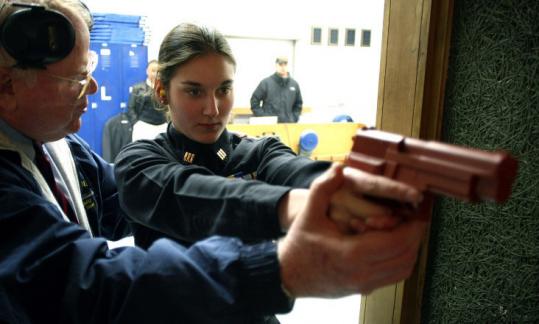
BOURNE - Amanda Priest unloaded five quick rounds from her 9mm pistol, the spent casings hurtling over her right shoulder before clattering to the cement floor. The soft-spoken Massachusetts Maritime Academy senior had fired a handgun for the first time
Her shots, part of a deafening volley from her fellow cadets enrolled in the school's first-ever firearms training course, were taking aim at a threat half a world away: the surge of piracy off the Horn of Africa, the continent's easternmost peninsula that juts into the Arabian Sea. With the spate of ship hijackings posing a growing menace to global trade, the military-style college, whose mascot is a buccaneer, is expanding its security training to deter crime on the high seas.
"The world has become a much more dangerous place, and it's a problem that is getting worse all the time," said Joseph Murphy, who teaches anti-piracy tactics in his maritime security class. "We're all keenly aware that the ante has been upped."
Murphy's teachings are personal: His son often travels in dangerous waters and was onboard a commercial ship sailing through the Gulf of Aden last April when pirates attacked a Japanese oil tanker a short distance away. That was one of 293 pirate attacks last year, a record number that included 49 hijackings and almost 900 hostages, according to the International Chamber of Commerce's global maritime bureau. Eleven were killed and 21 reported missing and are presumed dead.
For many academy graduates, their work will eventually take them to the Gulf of Aden, one of the world's most heavily traveled shipping lanes and a gateway to the Suez Canal.
On the deck of the college's training vessel, a former merchant ship named the TS Kennedy that is berthed at the mouth of the Cape Cod Canal, cadets learn to use radar to detect nearby craft, use high-pressure fire hoses to sink attacking boats, and steer the ship in a zigzag fashion to create a wake to ward off assailants.
Robert MacAleese, a senior majoring in marine transportation who hopes to become a deck officer, said training is vital, given the rising risk of piracy in trouble spots, which also include Southeast Asia and the Caribbean.
"In today's world, you need this," said MacAleese, a straight-backed 22-year-old from Walpole. "That's where the jobs are, and you need to know what to expect, and what actions to take."
In addition, about 10 percent of cadets at the school, which is structured as a military academy, will pursue military service, college officials said.
Looking on, the ship's master, Thomas L. Bushy, said he emphasizes deterrent tactics, such as vigilant watches, carefully planned routes, and evasive action. Contemporary pirates have traded daggers and cutlasses for automatic rifles and rocket-propelled grenades, and can easily overwhelm small and lightly armed crews if they can scramble aboard, officials said.
"If the pirates get onboard, it's all over for the crew," Murphy said, adding that merchant ships are bound by rules of engagement that prevent them from firing upon approaching pirate ships, and are often unarmed to begin with. Some ships have armed security teams capable of using force against attackers.
Modern-day pirates often launch small, fast-moving motorized craft from a larger ship, typically one disguised as a fishing vessel. The smaller boats can easily overtake a slow-moving freighter. These tactics allow pirates to range far from land, with some hijackings occurring more than 400 miles out at sea.
Increasingly, pirates are not only pillaging ships, but holding the crew hostage and successfully demanding huge ransoms. The growing scope and brazenness of the attacks has persuaded some companies to reroute ships around the southern tip of Africa.
Last week, Somali pirates hijacked two tankers within 24 hours. NATO announced that its anti-pirate force had resumed patrols in the pirate-plagued waters off the coast of Northeast Africa, joining a broader international mission that includes reconnaissance aircraft.
Basic weapons training is increasingly required for a range of other maritime careers, and officials believe it will give graduates a leg up in the job market.
"You want there to be no surprises," said Paul Kelly, vice chairman of the college's board of trustees and one of the firearms instructors.
Source: Boston Globe, March 30, 2009
But some parents have voiced concern about students' safety during training, and specialists question whether arming merchant ships is wise.
Donna Nincic, chairman of the department of maritime policy and management at California Maritime Academy at California State University, which includes piracy training in two courses, believes it will only escalate conflicts and increase the likelihood of casualties.
"Pirates can afford bigger weapons than we can," she said. "I feel that if you start arming merchant ships, you up the risk dramatically."
While an increasing number of commercial vessels are hiring private security teams for protection, Nincic said keeping a wary lookout is the best deterrent.
"It's pretty clear, the ships that have their act together don't get attacked," she said.
The Maine Maritime Academy is also creating an anti-piracy course, but it does not include gun training.
At in the indoor firing range at Mass. Maritime, Kelly worked with Priest on the proper firing stance. "Touch the target and lock the elbow," said Kelly, a former Secret Service agent. "That's going to give you a very stable firing platform."
Looking on after his turn, Matthew Duggan, a 22-year-old from Worcester who will work this summer for FEMA, admitted that he is "not really a gun guy."
"This would certainly be a last line of defense," he said with a wry chuckle.
Priest, a marine safety and environmental protection major, never imagined her college studies would involve firing a handgun, but was happy with her debut. She doubts she will come in harm's way in her upcoming job as an environmental protection agent at a shipyard in San Diego, but you never know.
"I didn't know what I was getting into, but it was fun," she said.
After reeling in the target, peppered with bullet holes, Kelly seemed hopeful.
"We can make you a shooter," he said.