
Friday, March 20, 2009
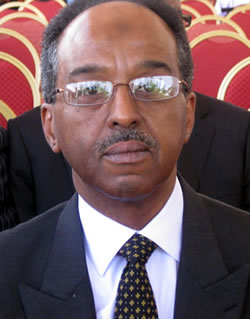 |
| Somali Foreign Minister Mohamed Abdullahi Omaar - Photo HOL |
Newly-appointed Omaar also pleaded for the immediate reinforcement of the African Union mission (AMISOM) propping up his wobbly transitional government.
He hailed the integration of transitional government troops and a faction of the opposition Alliance for the Re-liberation of Somalia (ARS) into the Joint Security Forces (JSF) following UN-brokered reconciliation talks in Djibouti last year.
"If the JSF is to be equipped by the international community to partner with AMISOM and to secure peace, the embargo on the government has to be re-addressed," he added.
"The JSF is not funded, resources or equipped up to now. Yet it is the essential partner of AMISOM for peacekeeping."
The UN Security Council embargo imposed in January 1992 has been constantly violated with weapons mainly coming from Yemen and financed by Eritrea as well as Arab and Islamic donors, according to a recent UN report.
"This needs to be undertaken immediately with improved equipment, logistics and medical facilities," he added.
AMISOM comprises Ugandan and Burundian contingents totalling around 3,400 men in Mogadishu, but has been unable to contain the violence that has raged since it was deployed in March 2009. The African Union had initially pledged 8,000 troops.
Omaar also stressed the importance of the April 22 Brussels conference, sponsored by the AU and the UN to raise funds for AMISOM and Somali security forces.
"Without these resources, visible and effective demonstration of the authority of the state and the rule of law will not be achieved and peace will not be secured," he noted.
Former rebel leader Sheikh Sharif Sheikh Ahmed, a moderate Islamist, was elected president of the war-ravaged African state in January following the Djibouti reconciliation talks, but faces a tough task to bring peace to a country wracked by civil war since 1991.
The Somali cabinet agreed on Tuesday to introduce Islamic law, a move Ahmed said was "to ensure that he who claims that he is fighting to have sharia no longer has a reason to fight."
Islamist fighters including the hardline Shebab militia have waged battles against the government and its allies since before Ahmed came to power, vowing to fight until all foreign forces withdraw and sharia law is imposed.
Somalia has had no effective central authority since the 1991 ouster of former president Mohamed Siad Barre touched off a bloody cycle of clashes between rival factions.
Source: AFP, Mar 20, 2009