
By David Clarke
Saturday, January 31, 2009
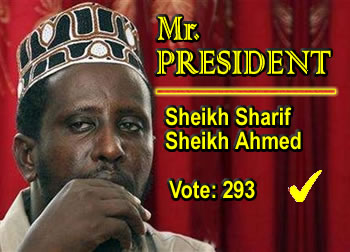 DJIBOUTI, Jan 31 (Reuters) - Moderate Islamist leader Sheikh Sharif Ahmed was sworn in after winning Somalia's president on Saturday and vowed to end conflict in the Horn of Africa nation, make peace with neighbours and rule with honesty and justice.
Analysts say Ahmed has a real chance of reuniting Somalis, given his Islamist roots, the backing of parliament and his acceptability to the West. But reconciling 10 million people and stopping 18 years of bloodshed remain a daunting task.
Ahmed headed the sharia courts movement that brought some stability to Mogadishu and most of south Somalia in 2006, despite being accused in the West of Islamist extremism, before Ethiopian troops invaded and drove it out.
"The conflict in Somalia will be resolved. We are urging our brothers in armed conflict to join us in peace-building," he told parliament. "We will govern the Somali people with honesty and justice, and give them back their rights."
His immediate task is to try to put together a unity government -- the 15th such attempt since Somalia descended into anarchy with the overthrow of the dictator Mohamed Siad Barre in 1991.
His election was held in Djibouti due to the instability at home. But the legislators hope they have elected a man able to isolate or even possibly bring on board hardline insurgents, even if violence may spike in the short term.
Despite the withdrawal of Ethiopian troops this week, and the U.N.-brokered Djibouti peace process intended to reconcile the government and opposition, hardline Islamist insurgents led by al Shabaab have vowed to fight on.
Al Shabaab, which is on Washington's list of foreign terrorist groups, said just before the vote that it would start a new campaign of hit-and-run attacks on the government -- whoever came to power.
The group's spokesman, Sheikh Mukhtar Robow Mansoor, urged jihadists to make ready in comments after prayers in Baidoa, the former seat of parliament that al Shabaab overran this week.
"Sheikh Sharif and the election in Djibouti is not something to be supported," Sheikh Hassan Yacqub, al Shabaab spokesman in the southern city of Kismayu, told Reuters on Saturday.
"MISINTERPRETATION OF ISLAM"
Ahmed said those fighting to impose a strict version of Islamic law throughout the country had misinterpreted the religion and he would try to correct that.
He also said his government would not tolerate any abuse of power or corruption and treat neighbours with respect.
U.N. envoy to Somalia, Ahmedou Ould-Abdallah, hailed Saturday's vote and called for a spirit of unity.
The Arab League also sent congratulations and urged "comprehensive Somali reconciliation."
Somalia expert John Prendergast, co-chairman of the U.S.-based advocacy group the Enough Project, cautioned that the election was just a "tiny step" towards peace.
"What lies ahead in a best-case scenario is a painfully slow political process," he said.
"The tent that Sheikh Sharif will preside over will have to be wide and deep, and consciously include genuine representatives of all clans, ideologies and regions ... (or) Somalia will continue to bleed."
In the past two years, more than 17,400 civilians and an unknown number of combatants have died during an Islamist-led insurgency against the government and its Ethiopian allies.
A third of the population relies on food aid.
Under Somalia's complicated clan system, Ahmed, a Hawiye, will now seek to appoint a Darod prime minister to ensure representation of the major groups.
Many Somalis doubted that Ahmed's election would bring peace, saying the armed threat from hardliners remained, and an election brokered abroad may lack legitimacy in the eyes of some.
"Sheikh Sharif will face a security challenge from al Shabaab. These chaotic Islamists will take no heed of his election. He will never tackle Somalia's crisis unless he is fully supported by the international community," said a Mogadishu local elder, Abdiqadir Farah. (Additional reporting by Abdi Sheikh and Abdi Guled in Mogadishu and Abdiaziz Hassan in Djibouti; Editing by Wangui Kanina and Kevin Liffey).
Source: Reuters, Jan 31, 2009