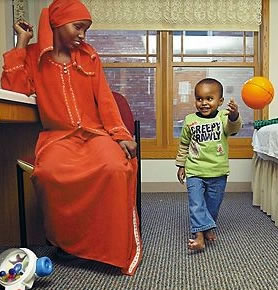
Mohamed Ali, 2, plays with a ball while his mother, Jawhar Mohamed, looks on in their room at the Ronald McDonald House in Rochester. The child is recovering following his first surgery to repair bladder estrophy, a congenital urinary birth defect.
Michele Jokinen/Post-Bulletin
By Jeff Hansel
Post-Bulletin, Rochester MN
Saturday, February 14, 20094
Abdiaziz Maahaay's urgency gets tempered with the need to first help whoever's most in need.
Maahaay, 39, of Rochester, started a nonprofit for people from Somalia, mostly children, who live with disfigurement. Most get help directly in Africa.
But two children came for treatment at Mayo Clinic in Rochester. One, an 11-year-old girl, needed surgery after a violent rape by armed rebels. Another, a 3-year-old boy born with bladder and abdominal malformation, got his first surgery in Rochester.
Maahaay can't turn his back on them, and he seeks help from anyone who will listen.
After 17 years of war in Somalia, he says, "everything has been destroyed." Even normal medical care is unavailable.
"This is what I get, e-mails, daily," Maahaay says as photo after photo of people in need fades from his computer screen -- a woman shot in the face, another who had a tumor in her mouth.
"I'm very proud of what he's doing, and his efforts," says Jon Eckhoff, owner of Venture Computer Systems, which hosts Maahaay's Web site for free.
"Abdi has a presence that makes you feel good to be around him, and he has everybody's interests ahead of his own. ... I wish we could help the whole world. But Abdi is going to do it one person at a time."
To reach a Kenyan hospital, individuals must first fly to Uganda and then ride to Kenya's capital city of Nairobi. They need heart, neural and repairative surgery. Some surgeries can be done in Kenya, others can't. But all cost money, as does staying in Kenya.
"They live there, and I have send them monthly $100 to $150," Maahaay says. For each, he says, "maybe it takes $25,000 to repair. I don't have it."
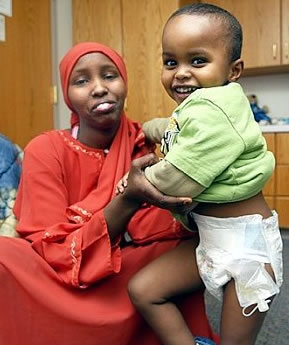 |
| Jawhar Mohamed came from Kismayo, Somalia, to seek treatment for a rare birth defect that affected her 2-year-old son, Mohamed. The toddler was born with his bladder on the outside of his body, and there were no specialists who could treat the condition in war-torn Somalia or in neighboring Kenya. Michele Jokinen/Post-Bulletin |
The hospital in Kenya is the lifeline, he says. Thousands visit there daily, from as far away as Uganda, Somalia and Sudan.
"I want the Rochester people, not only the Somali people but the community of Rochester, to help this hospital survive and prosper," he says.
To make it work, he drains his own resources.
"When I started this I thought I could save one child. But when I looked, it was a second child, and a third child, and now it's more than 26 -- and it's hard sometimes. But I say to myself, 'Sacrifice, and I can save a child's life.'"
Reporter Jeff Hansel covers health for the Post-Bulletin. Read his blog, Pulse on Health, at http://postbulletin.typepad.com/pulse_on_health/ .