Tuesday, April 21, 2009
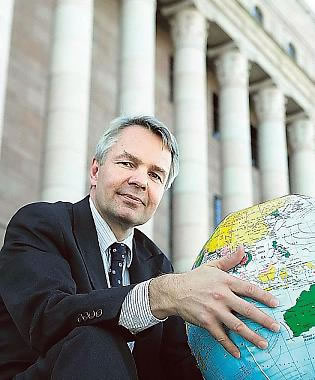 |
| Pekka Haavisto -Special Representative for African crises at the Finnish Ministry for Foreign Affairs.
|
I am on flight XU521 en route from Nairobi to Mogadishu. In the classification for safety by the UN, Mogadishu ranks in category five. According to the rules, workers must be evacuated immediately, and the countries should not be visited except in cases of urgent need.
The flight from Nairobi to Mogadishu is short - one hour and 20 minutes. As the plane loses altitude, a yellow beach and a gleaming turquoise sea can be seen. Then it is possible to discern children wading in the water near the shore, looking for maritime treasure. A small fishing vessel has left a long wake behind it.
It looks like paradise.
Mogadishu Airport is very neat. As is the case in other parts of Africa, remnants of planes which were less lucky on takeoff and landing have been left on the side of the runways. But African Express lands professionally, and when the door of the plane opens, the heat of an April day floods in.
A row of welcomers stand at the airport: the government of Somalia and the AMISOM peacekeeping mission of the African Union are prepared for my arrival.
advertisements
My ride is also ready: a Ugandan armoured personnel carrier, with three peacekeepers armed with submachine guns standing on the seats, with their heads sticking out of the openings. A convoy is formed at the airport, in which two pickup trucks full of Somali soldiers wearing red berets ride in front of two armoured personnel carriers. The iron gates open, and the procession gets on the move. Welcome to Mogadishu!
We seem to be moving fast as we curve onto the unpaved main street. The personnel carriers bounce and rattle. We arrive at a square.
“This place is called Kilometre Four. It is the distance from here to the centre of Mogadishu. This is the place where they usually shoot."
I crouch down a bit lower. “They” are fighters opposed to the Somali government. However, nothing happens.
In any other country, things would feel quite safe with the protection of both government forces and peacekeepers. However, in Somalia, they control a very small part of the capital - basically the airport and the Presidential palace. The route between them passes through no-man’s land.
“We used to play football there when we were children”, says Abdirahman. He is responsible for the international contacts of the President.
The bumpy pitch is full of junk. Around its edges stand buildings that have lost their walls, whose roofs droop, supported by twisted iron concrete reinforcement rods. Hardly any people are to be seen.
“And there we always went to the movies. This was the most peaceful city in the world.”
The windows of the cinema that he pointed at are boarded up. The roof has been hit, and there are bullet holes around the walls. If a set for an urban war were to be built on a back lot in Hollywood, it would probably look like this. And this is the main street.
Already from afar we can see that somebody has done some strange parking. The rear of a lorry partly blocks the road in front of us.
“They sometimes put car bombs into things like that”, Abdirahman says.
Instinctively I put my head down again. We drive past quickly. The people seem to be simply changing a tyre. The danger is past.
At the gates of the administrative area, the Ugandan peacekeepers raise the barrier, and we leave the pick-ups with the Somali soldiers and their red berets behind.
When the armoured vehicles go through the gates, the Ugandans shake hands: “Well done!”
Their joy seems to be genuine. Another successful drive through the city.
Planning a trip is always half of the effort.
When going to Mogadishu, planning is even more important. First one might sit on a cardboard box at Abdullah’s shop in the centre of Espoo.
There are also Mogadishu refugees in Kenya, Somaliland, Washington, Ottawa, Sydney, London, and in the Espoo neighbourhood of Suvela.
In addition to Espoo, it is a good idea to visit Asmara, the capital of Eritrea.
Eritrea houses the part of the Somali opposition that does not accept the peace talks which began in Djibouti last year, in which the present government was chosen.
At the Sunshine Hotel in Asmara I am accompanied at my table by Mr. Hashi, Somalia’s former Ambassador to the UN. He is in exile.
I draw on the map of Mogadishu and ask if this is part of the territory of Sheikh Omar, the leader of the new Islamic party. And what about Insha Cadde “White Eyes”? Who has fallen out with him? Where are his fighters moving about? Where is the area of influence of the Al-Shabbab (Youth) resistance movement?
Does the Hawye clan, which controls Mogadishu, have soldiers?
And whose forces will Sheikh Aweys, who is wanted by the UN and the United States, join when he returns to Somalia through Sudan?
Then comes a more difficult phase. All these people must certainly have a Nokia cellphone.
Getting telephone numbers is a professional secret of peace negotiators, whose risks are not revealed to others.
Finally I get a small notebook full of numbers to groups who hold the power in Mogadishu. And there are quite a few of these. So it is best to call them all and ask if I am welcome in the city.
Phoning guys who fire shells at Mogadishu Airport or set car bombs on the routes of peacekeepers is naturally not part of the instructions.
Usually the advice is that when visiting dangerous places, nobody should be informed about the visit in advance.
However, if peace is ever to be achieved in Somalia, it is necessary to talk to all groups. So it would be best to start right away.
At the moment, Islamists in Somalia are fighting other Islamists. The international community supports the government led by Sheikh Sharif; he was elected President in Djibouti in January.
Sheikh Sharif and his allies were in power also in 2006, but only for six months. Then the Ethiopians came to Somalia, supported by the Americans, and the Islamists were sent into exile.
When the Ethiopians withdrew, some of the Islamists returned to the negotiating table under the leadership of Sheikh Sharif - and now he is acceptable to the international community as the president.
However, the most radical Islamists and the Al-Shabbab resistance movement will not accept the compromises that he has made.
The former Presidential palace, Villa Somalia, looks beautiful: the light-coloured building is on a high hill, and has a dazzling view of the city, the harbour, and the sea.
Villa Somalia is surrounded by administrative buildings, of which the house of parliament is admittedly in ruins.
My accommodation is in Villa Somalia.
“You are the first foreign overnight guest, congratulations!”, Abdulkareem, the President’s Chief of Staff says, laughing.
I open the door to the balcony and ask instinctively, “Are there snipers here?”
“No... but going on the balcony is still at your own risk”, comes the answer.
Well, everything in this city is at one’s own risk.
We look at the green landscape of the city. Somalia’s long-term President Siad Barre (1969-1991) ordered the planting of a tree in the yard of every house. Now the results can be seen.
Living trees hide the buildings that have been damaged in the fighting.
The sea shines in bright turquoise, and a few ships can be seen bobbing in the distance. We talk about the US captain Richard Phillips, who is being held by pirates in a small lifeboat off the same coast.
The government does not have a coastguard or a navy, so it is powerless to do anything about the pirates.
Piracy is seen as a business: “I invested half a million dollars in the hijacking. How should I not be entitled to ask for a 10-million-dollar ransom to back up my investment and interest?” asks one of the hijackers.
This is my first visit to Mogadishu. I meet everyone who can influence peace. The Somali women who talk about peace make an impact on me.
“We paid for the professional training of 150 young men and took the weapons away from them”, the women said with pride. “Everything in this country runs on what the women do, now that the men are stuck on fighting.”
I sit with a group of representatives of civic organisations, businessmen, and village elders. Then come Members of Parliament, ministers, the Prime Minister, and finally the President, Sheikh Sarif.
Everyone talks about negotiations, and about Finnish aid to Somalia.
Many also mention the tuberculosis hospital financed by Finland. Hopes are expressed for humanitarian aid and support for education.
Finland is praised for receiving those who have fled the war.
“Greetings to Abdullah”, says the President.
“Thank you, thank you, I'll pass them on”, I answer and think about Abdullah, who is busy in the midst of all of the cardboard boxes in the centre of Espoo.
In the evening the events and the tension merge into a deep sleep. I dream about the rabbits in Helsinki. In my dream they hop, smirk, and do acrobatics.
In the morning I wake up in Villa Somalia to the sound of conversation outside my door. Government civil servants and peacekeepers are there.
“I hope you didn’t wake up in the night”, they ask.
“No, no, I slept like a log.”
“There was an attack on the camp of the Ugandan peacekeepers. There was an exchange of fire. We came to sleep behind your door because we thought that you might be worried about the sounds of the fighting.”
How considerate of them.
On Good Friday, the convoy prepares for the return trip.
The same fast drive in armoured personnel carriers, and when the gates of the airport are closed behind us, the Ugandans congratulate each other again.
“Surely you didn’t spend the night there?” the African Express flight attendant asks almost aghast.
And then the plane takes off. There is a night flight from Nairobi via Istanbul to Helsinki.
Here the snow had melted while I was gone. Two rabbits hop around in the yard of my home.
I go to the Somali news on the Internet.
A plane carrying US Congressman Donald Payne was fired on at Mogadishu Airport by insurgents on the day after my departure. Payne was unhurt, but some Somalis living nearby were killed by stray mortar fire.
Mogadishu is still dangerous.
Helsingin Sanomat / First published in print 19.4.2009
The writer is the Special Representative for African crises at the Finnish Ministry for Foreign Affairs. He visited Mogadishu during the week immediately before Easter.