
By Wangui Kanina
Friday, October 31, 2008
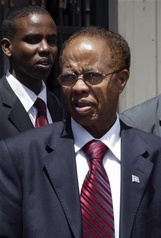 NAIROBI (Reuters) - The main priority for Somalia's interim government is to form a new cabinet within 15 days as demanded by east African leaders at crisis talks in Kenya, the Somali prime minister said on Friday.
Regional heads of states who met in Nairobi on Wednesday demanded that the four-year Somali administration name a new cabinet, show quick progress on political reconciliation and reverse the country's slide into rampant insecurity.
At the same time, five coordinated car bombings killed about 30 people across northern Somalia. Suspicion fell on Islamist insurgents battling the government and its Ethiopian allies.
"Definitely our main priority is the composition of a new cabinet in the time frame stipulated," Somali Prime Minister Nur Hassan Hussein told a news conference in Nairobi.
"This will depend upon the progress ... to see a national united government including the TFG (Transitional Federal Government) and the opposition," Hussein said.
"We will have an inclusive parliament. This will bring about the possibility of extending the transition period."
COORDINATED BLASTS
Authorities in northern Somalia arrested a prominent local sheikh on Thursday and others suspected of involvement in the suicide attacks a day earlier. There was still no clear claim of responsibility for the five bombs in Puntland and Somaliland.
The United States blamed al Qaeda, which it says works through the local militant group al Shabaab. It posted a 30-minute online video on Thursday containing the last testament of a suicide bomber identified as Abdel Aziz Saad.
Both Somaliland and Puntland had been relatively quiet in recent months compared with southern Somalia. The coordinated blasts would mark a return north for al Shabaab -- where its members were blamed for some attacks on aid workers several years ago -- if it is confirmed the group was behind them.
The violence in Somalia has killed nearly 10,000 civilians since the start of 2007 and forced more than a million from their homes, triggering a humanitarian crisis aid workers say is one of the worst -- and most neglected -- in the world.
Source: Reuters, Oct 31, 2008