Bloomberg.com
By Caroline Alexander and Alaric Nightingale
Monday, November 17, 2008
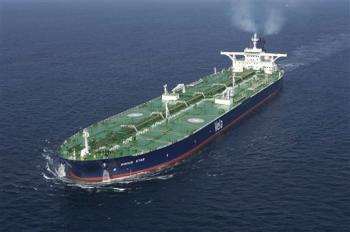 |
| Undated picture of 'Sirius Star' tanker conducting trial run in South Korea
|
The Saudi Arabian Oil Co. tanker, Sirius Star, was carrying crude oil when a group of pirates scaled the 10-meter (32-foot) side of the ship, Lieutenant Nate Christensen of the U.S. Navy's Fifth Fleet said by telephone from Bahrain. The vessel was last seen on Nov. 10 leaving the Persian Gulf, bound for St. Eustatius in the Caribbean Sea, according to tracking data on Bloomberg.
``Threatening the most valuable ships in the world has taken it up to a whole new level,'' Roger Middleton, a London-based consultant researcher at Chatham House, said today by telephone. ``It's hard to see it won't have an unpleasant effect for shipping companies' insurance.''
St. Eustatius
``The tanker was heading to NuStar's St. Eustatius terminal,'' Greg Matula, a spokesman for NuStar Energy LP, said in an e-mail. ``But the crude is not ours -- it would only be stored at our terminal in tankage leased by Saudi.'' NuStar Energy operates the St. Eustatius Statia Terminals, Netherlands Antilles. The facility has 56 tanks with 13 million barrels of storage capacity.
Dhahran-based Saudi Aramco declined to comment on the incident, and Vela International, Aramco's shipping unit, couldn't immediately be reached for comment by phone or e-mail.
Fifth Fleet Commander Jane Campbell said the incident occurred 450 miles southeast of Mombasa, Kenya, and the ship is now approaching anchorage near Somalia's northern semi-autonmous region of Puntland. She denied reports from Al-Arabiya television that it had been freed.
``It's quite an escalation,'' said Tudor Ellis, maritime security expert at Drum Cussac, a London-based risk advisory company. ``They've taken chemical tankers before and they've attacked oil tankers, but they've never taken an oil tanker before.''
Seizure
The tanker was seized at around 7:20 a.m. local time on Nov. 15, Cyrus Mody, an official at the International Maritime Bureau, said by phone, adding the IMB had no further information.
The bureau, which compiles data on piracy, said the incident took place 450 miles southeast of Mogadishu, Somalia, though the Navy reiterated that it happened off Mombasa. The Navy said that even as the pirates were becoming more brazen in their attacks, the percentage of successful hijacks fell from 53% in August to 31% in October, citing Combined Maritime Forces data analysis.
The European Union last month joined the North Atlantic Treaty Organization, India, Malaysia and Russia in deploying vessels to combat piracy.
Odfjell SE, the world's largest chemicals shipping line, said its vessels sail around Africa, rather than risk attacks near the Suez Canal and Gulf of Aden.
`Successfully Expanding'
Sirius Star, designed to carry more than 2 million barrels of crude, ``is three times the size of a U.S. aircraft carrier and shows how they are successfully expanding their operations,'' Christensen said, adding that previous attacks have occurred within 200 nautical miles of land.
Piracy in the Gulf of Aden, between Yemen and Somalia and leading to the Suez Canal, has more than doubled in 2008, with assailants using the global positioning system and satellite phones to find potential targets, according to an October report by Chatham House.
The attacks may force shipping away from the Gulf of Aden to take the longer route to Europe and North America round South Africa's Cape of Good Hope. The extra weeks of sailing and fuel consumption could have a major impact on oil and commodity prices, the London-based research organization said.
The Sirius Star's crew of 25 includes citizens of Croatia, the U.K., the Philippines, Poland and Saudi Arabia, Christensen said. The Navy is evaluating the situation, he said when asked what measures were being taken to free the vessel.
Opportunistic
The attack was ``probably opportunistic,'' Mark Jenkins, an analyst at Simpson, Spence & Young Ltd., the world's second- largest shipbroker, said by phone. Failure to increase the protection of its fleet would probably ``compromise'' Saudi Aramco's ability to sell oil to customers in the U.S. and Europe, Jenkins said.
``Even if you've got to spend quite a lot of money, it's going to be a worthwhile investment if the alternative is you can't sell the oil as readily as you would otherwise aim to do,'' he said.
Crude oil for December delivery rose as high as $58.98 a barrel by 11:06 a.m. New York time, recovering from an earlier low of $55.29 on the New York Mercantile Exchange.
To contact the reporters on this story: Caroline Alexander in London at [email protected]; Alaric Nightingale in London at [email protected]
Source: Bloomberg, Nov 17, 2008