
By Elizabeth Gorman
Thursday, July 24, 2008
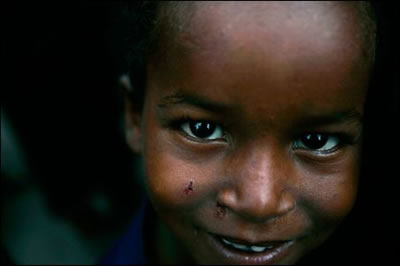 |
| REUTERS/Khaled Abdullah Ali Al Mahdi |
Autism is a developmental disorder that doesn't discriminate against race or class, and it is on the rise in the United States. But in Minneapolis, the mysterious disorder appears to be zeroing in on one of the city's newest communities: First generation U.S.-born Somali-speaking children in Minneapolis schools are disproportionately identified as having autism.
"We're definitely seeing it, and something is triggering it," said Dr. Chris Bentley, director of Fraser, a non-profit in Minneapolis that assists autistic children and their families.
Bentley is helping organize an unusual forum next month to discuss the issue. Members of the Somali community, autism advocates and officials at the state departments of health, education and human services have been invited to attend.
No conclusive research
It's not clear what's going on in other communities — such as St. Paul and Rochester, Minn. — with large numbers of Somali children because data there is less complete or unavailable.
And metro-area pediatricians couldn't confirm that there is higher incidence of autism among Somali children in the Twin Cities, noting that there's been little research on the question.
But, said Dr. Stacene Maroushek of Hennepin County Medical Center's pediatric clinic, "the impression that there's an increasing rate of autism in the Somali community is definitely there. And people are wondering what's going on."
Maroushek said that while there is a need for more medical research on immigrants and refugees, there is no conclusive medical data showing disproportionate numbers of Somali children with autism in Minneapolis.
The Minnesota Department of Health is scrambling to put together a "pre-pilot program" to assess autism in the general population. It has not developed a plan to assess numbers of immigrant children with autism, in part because of laws restricting access to school data.
In the meantime, there is concern in Minneapolis public schools.
The Minnesota Health Department estimates 1 percent of Minnesota's children have autism. But the Minnesota Department of Education said that in the Minneapolis' early childhood and kindergarten programs, more than 12 percent of the students with autism reported speaking Somali at home. According to Minneapolis school officials, more than 17 percent of the children in the district's early childhood special education autism program are Somali speaking.
Almost 6 percent of the district's total enrollment is made up of Somali-speaking students, and about 6 percent of the children in the district's overall early childhood and kindergarten special education programs are Somali.
About a quarter of all autism children who attend autism classrooms for students functioning too low to be mainstreamed in regular schoolrooms are Somali. Special education specialists said that indicates that the degree of autism Somali children are developing is on the severe end of the autism spectrum.
"I'm not seeing Aspergers syndrome and the full spectrum of autism in Somali children. It is the more classic forms of autism in general; it is the more severe forms of autism that we're seeing in our Somali babies that are born here," said Anne Harrington, early childhood special education coordinator for the Minneapolis district and a specialist on the topic.
"If they're having more children, many of the siblings also have autism. We have a number of [Somali] families who have two children on the autism spectrum and sometimes more. I've been working to get somebody to look at this and pay attention because it feels like this is too specific [to Somalis]. It's got to be preventable," Harrington said.
She said she knows of an apartment building with Somali residents in which almost every family has at least one autistic child.
A huge issue
Harrington said the Somali community is struggling to understand and recognize autism. She said that among Somali families there has been a lot of shame and confusion associated with having an autistic child. But that's changing. "They're beginning to be aware that this is a huge issue in their community, and they're starting to come together and not isolate themselves," she said.
According to a 2001 state health department study, there are an estimated 15,000 to 40,000 Somalis living in Minnesota, the biggest Somali population outside of East Africa. The state estimates that 67 percent of refugees who arrived in 2000, when Minnesota saw the biggest surge of Somali refugees, settled in Hennepin County. And nearly a third of all students who speak Somali at home in Minnesota attend Minneapolis public schools.
Harrington suggested that differences in the genetic make-up of Africans put them more at risk for developing autism than other immigrant groups, and noted that refugee women and children must undergo numerous immunizations.
(According to school data, the percentage of Hmong children and Latino children in Minneapolis public schools with autism is not as high as Somali children with autism.)
Harrington raised issues that are part of a long-standing debate over whether immunizations are linked to autism.
"They're given more [vaccines] then we get, and sometimes they're doubled up," Harrington said. "Then their children are given immunizations. In Somalia, their generations have not received these immunizations, and then suddenly they're getting just a wallop of them in the moms and then in the babies. That's certainly a concern that's been expressed to me by the Somali population."
The Centers for Disease Control and Prevention's Advisory Committee on Immunization Practices recommends that refugee adults receive at least 10 vaccines.
But numerous studies have failed to prove any connection with symptoms of autism in children and vaccines.
"Research has not shown it's related to shots or toxins — kids who haven't received immunizations have the same baseline [for autism] as those who have," said HCMC's Maroushek.
Study in Sweden
There are some studies, however, that link autism and ancestry.
A Swedish newspaper published an article last week about that country's Somali population and its high prevalence of autism. The story described a autism study that focused on Somalis. Doctors hypothesized that the high rates of autism in Somali children born in Sweden is due to the lower levels of sunlight and vitamin D immigrants get in Sweden compared with Somalia, a country near the equator. Dark skin that's covered up and a diet that doesn't include fatty fish limits absorption of vitamin D as well, according to the doctors.
And the journal Science published a study last week that linked shared ancestry to autism. (The study was also described in the Times of London.) A Harvard team funded by the National Institute of Mental Health studied Middle Eastern families in which cousins had married each other. In five of those cases, children showed genetic defects linked to autism. Many Muslim Somalis marry their first, second or third cousins, putting them a category suspected to be more at risk.
Struggle to find care
While experts are baffled by the causes of autism in U.S.-born Somali children, autism advocates say that the problem is compounded because Somali families struggle to find health services.
According to Huda Farah, a Somali advocate who collaborates with the health department and trains childcare providers who work with autistic Somali children, language barriers and a lack of understanding of the complex U.S. medical system are key reasons why many Somali parents don't seek medical help for their autistic children.
Cultural barriers also impede: Unlike in the United States, children in Somalia aren't taken to a doctor for developmental disorders.
Because Somali parents aren't seeking medical help for their autistic children, it's usually teachers who identify and track autism among those children, according to the Autism Society of America. Schools, however, do not make a formal autism diagnosis, but rather look to see if a child meets educational criteria to be placed in autism programs. Nor do Minneapolis schools to refer children with autism to medical doctors.
Elizabeth Gorman is a freelance journalist in Minneapolis. She also works at Minneapolis Public Schools as a Spanish bilingual educator.
Source: MinnPost, July 23, 2008