An unprecedented escalation in violence and worsening humanitarian crisis have earned little notice in the West

STEPHANIE NOLEN
Tuesday, January 1, 2008
ABOUT THE SERIES
 |
|
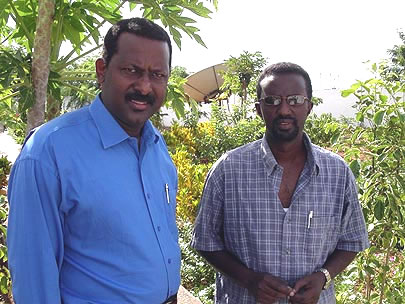
The Late Ali Iman and Ahmed Abdisalam Adan |
Never, Ahmed Abdisalam Adan says, has it been this bad.
The Somali journalist, who built a new life in Canada before moving back to start an independent media house in Mogadishu eight years ago, knows whereof he speaks: He lived through some of the worst of Somalia's civil war, and through the strange anarchic years that followed, when a country without a government somehow lurched along.
Now, however, Mr. Adan is living in Nairobi, afraid to go to the Somali capital after his partner and a reporter for his HornAfrik Media were assassinated in August.
While Somalia is, it seems, perpetually in the news, the last year has seen an unprecedented escalation in the conflict, and 2008 looks set to be even worse, as the humanitarian crisis worsens and more regional actors get dragged into the fighting. Yet few of these developments have won notice in the West, accustomed as it is to the same old bad news out of Somalia.
Mr. Adan's views are echoed by many other observers: "We're not talking here about different clan militias waging war; we're talking about a complex political dynamic that has a lot of interest for the West in terms of counterterrorism efforts," said Leslie Lefkow, who monitors Somalia for Human Rights Watch.
The country's current troubles began in 2004, when a long-negotiated peace deal produced a transitional government made up largely of warlords. But other chieftains ruling patches of Somalia refused to accept its authority and President Abdullahi Yusuf never made it to the capital.
Before long, the new government's lack of legitimacy and support were apparent, and a new power arose in the vacuum. In June, 2006, an organization calling itself the Islamic Courts seized control of the capital and then much of the rest of southern Somalia. Its leaders imposed sharia, or strict Islamic law, but Somalis were delighted with the peace and stability they brought; for the first time in more than a decade, people walked Mogadishu's streets without fear.
But the Islamic rulers threatened (perhaps with serious intent but dubious ability to implement) jihad against neighbouring Ethiopia, a historic enemy that was continually sending troops over the border and denying it.
So Ethiopia took action a year ago on Christmas Eve, when the developed world was paying even less attention than usual, and invaded, saying it acted to install the "rightful" transitional government of President Yusuf in Mogadishu. The Ethiopians used the fashionable language of rooting out terrorism, and quickly got support from their ally the United States, which provided missile attacks to back up the invasion.
The Ethiopians said they would stay only long enough to install President Yusuf and hand over to an African peacekeeping force. But a year later, the Ethiopian forces are still there, routinely shelling residential neighbourhoods of Mogadishu while the Islamists wage an "Iraq style" insurgency of suicide bombings and assassinations of civil-society leaders and journalists such as those from HornAfrik.
The conflict has killed at least 6,501 civilians in the capital Mogadishu in 2007 and wounded 8,516 more, according to a count released yesterday by the Elman Peace and Human Rights Organization, a local group. The latest victims were eight members of a single family killed Sunday by a mortar fired during fighting between Somali insurgents and Ethiopian troops at a refugee camp north of Mogadishu.
"The core problem was that Somalis everywhere were appalled to see Ethiopian troops on the streets of their capital," Sally Healy, an expert on the Horn of Africa with the English international affairs think tank Chatham House, wrote recently in Johannesburg's Mail and Guardian.
"What kind of government, they asked, needed the protection of a foreign force against its own citizens? An insurgency was born [and] Ethiopia's rampage through the city ... hardened the insurgents' resolve, and made new enemies among the clans targeted; it deepened opposition to the transitional government, in whose name the operations were conducted; it prompted the flight of the business people so vital for any normalization; and it alarmed African nations who might have considered joining the small Ugandan contingent to provide security and enable the Ethiopian forces to leave."
After a year of this, a million people have become internal refugees in Somalia - the worst humanitarian crisis anywhere today. Hundreds of thousands of people are camped in desperate conditions on roads out of the city. Aid agencies are nearly powerless to help in the unstable and dangerous conditions; in sharp contrast to Darfur, flooded with aid groups, there is virtually no help for Somalis.
Unicef said earlier this month that 1.5 million children were in a dire situation, with critical shortages of food, water and medicine, plus widespread exhaustion and emotional trauma from the fighting. Many refugees are struggling to get to Kenya, which is already home to tens of thousands of Somali refugees. Ms. Lefkow noted that the fighting has also increased the movement of weapons through the region.
Both she and Mr. Adan see Ethiopia fighting out its grudge with neighbour Eritrea on Somali soil. (Eritrea backs various Somali rebel groups, as a way to destabilize Ethiopia.) "It's much easier to fight it here than on their territory," Mr. Adan said bitterly.
Already the fighting has spread to other parts of Somalia, and Abdullah HajAli Ahmed, a member of the opposition in the transitional government based in Baidoa, said it is going to spread further.
"I don't know whether Somalis have the capacity militarily or organizationally to take the conflict to the [Ethiopian] border - but it's a matter of time before you have the export of fanatics" who would threaten Ethiopia and any of its allies, he said. "If we don't solve this problem in Mogadishu for once and for all, it will develop into some kind of different form of continuing war."
Mr. Adan said the U.S. military intervention and the free hand it gave the Ethiopians has had the opposite effect of stamping out Islamist terrorism: While only a handful of people were affiliated with al-Qaeda before this crisis - people who could have been controlled by paying for their assassination - there is now widespread support for the Islamists, he said. "Now it's at a point where the U.S. can do nothing about it - every child is now fighting, saying, 'Anyway, we're dying, so what's the point; the best thing you can do is defend your country and your religion' - now there is no way to control it or to contain it."
Ms. Lefkow said the Ethiopians have been given a free hand - the U.S. denies any knowledge of abuses committed by Ethiopians in Somalia. "Ethiopia is not getting any pressure about its behaviour," she said. "Overlooking and ignoring the level of human-rights abuses is simply unacceptable."
The international community must get involved to try to check the crisis, Mr. Ahmed said, before it worsens any further. "It will take international pressure to get the Ethiopians out, because they won't leave on their own," he said. "But the government doesn't have the will or the ability to replace the Ethiopians. We need an international force, from Africa or beyond. And then this government has to go. We can't use them to establish stability."
To understand Somalia's history, society, and above all its politics, it is important to understand its clans. WHY ARE CLANS IMPORTANT?
The clans control districts and businesses and are the arbiters of most aspects of Somali life. Decisions are made collectively within the clans and their complex subdivisions.
An internationally recognized interim government formed in 2004 was created on a "4.5" clan structure, meaning major positions were split between the four main clans. The remaining 0.5 share was given to a grouping of smaller clans sometimes called the Fifth Clan.
Some Somali nationalists argue that the 4.5 system has had the effect of fracturing Somalia on clan lines by imposing a federal system. They say that system - historically a solution for uniting ethnically diverse countries such as Ethiopia - is totally unsuited for Somalia, one of the most ethnically unified countries in sub-Saharan Africa. MAIN CLANS AND PLAYERS HAWIYE CLAN: New Prime Minister Nur Hassan Hussein hails from the Abgal sub-clan, same as his predecessor Ali Mohamed Gedi - who resigned under pressure. Sheikh Hassan Dahir Aweys, now exiled in Eritrea after the government and Ethiopian troops defeated his militant Islamist movement in January, is from the Ayr wing of the Habr Gedir sub-clan. Sheikh Aweys's Afghanistan-trained protégé Aden Hashi Ayro, said to be leading the Mogadishu insurgency, is also an Ayr. DAROD CLAN: Ex-dictator Mohamed Siad Barre, ousted in 1991, came from the Marehan sub-clan. President Abdullahi Yusuf is from the Majerteen wing of the clan. Since he is a Darod, the prime minister must be Hawiye. ISAAQ CLAN: The Education Minister, Ismail Hurre Buuba, is from the Dir sub-clan of Iidagale. RAHANWEYN: Parliamentary Speaker Sheikh Adan Madobe comes from this line via the Hadame sub-clan. FIFTH CLAN: Mohamed Omar Dalha, the deputy parliament speaker, is a member of this clan via the Jarererweyne sub-clan. That sub-clan is made up of Somalis from the ethnic Bantu minority originally brought to Somalia by slave traders, from what is now Mozambique, Tanzania and Malawi. CLAN ROLES IN RECENT HISTORY
Hawiye dissatisfaction has played a major role in the travails of the interim government since its inception in late 2004. Many Hawiye felt that Mr. Gedi was imposed on them as prime minister by Ethiopian pressure, hence cheating them of real influence in the clan's top government position. That dissatisfaction manifested itself in an Islamist movement that controlled Mogadishu for the latter half of 2006, until its defeat by Ethiopia and Somalia over the new year. Some Hawiye are still involved in the current insurgency. It remains to be seen what welcome the clan will give the new Prime Minister.
Somalia's last national president, the dictator Mr. Barre, was blamed by many Somalis for favouring members of his Marehan sub-clan and discriminating against others, often brutally. That spurred Darods in northeastern Somalia who felt marginalized to rise up against his government, followed by Dir from what is now self-declared Somaliland. Mr. Barre's actions are said by Somalis to underpin much of the current Darod-Hawiye mistrust. Reuters News Agency
Source: Globe and Mail, Jan 01, 2007