
Ethiopia, which has been protecting the Somali government, recently announced it would withdraw its troops by the end of this month. This will leave the government vulnerable to Islamic insurgents, who have captured most of southern Somalia up to a few miles (kilometers) from Mogadishu and move freely inside the city.
"The international community should play their role now, and not tomorrow, to avoid any power vacuum," Prime Minister Nur Hassan Hussein told The Associated Press in an interview from the patio of a hotel in Nairobi, Kenya.
Civilians have taken the brunt of the violence surrounding the insurgency, with thousands killed or maimed by mortar shells, machine-gun crossfire and grenades. The United Nations says there are around 300,000 acutely malnourished children in Somalia, but attacks and kidnappings of aid workers have shut down many
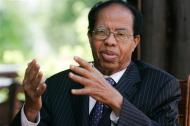 |
| Somali Prime Minister Nur Hassan Hussein speaks to The Associated Press, in Nairobi Tuesday, Dec. 2, 2008. Somalia's prime minister said Tuesday his country is at a dangerous crossroads and cannot emerge from nearly 20 years of chaos without urgent international help. (AP Photo/Sayyid Azim) |
Somalia has urged the United Nations to send a peacekeeping force, which the U.N. Security Council said was possible if the country can improve its security situation.
The United States worries Somalia could be a terrorist breeding ground, and accuses a faction known as al-Shabab — "The Youth" — of harboring the al-Qaida-linked terrorists who allegedly blew up the U.S. embassies in Kenya and Tanzania in 1998.
Hussein said al-Shabab was recruiting from Somalia's disaffected youth, and that establishing peace might require reaching out to those youths with opportunities.
"We have young people who are jobless, who are utilized in this fighting," he said.
Ideally, Hussein said, the Ethiopians would withdraw only after an international force is in place.
"I don't think Ethiopia will forget Somalia and leave like that," he said, but added that international groups should not delay in sending forces.
The two countries are traditional rivals, and many Somalis to see the Ethiopians as "occupiers." Ethiopia's critics have accused the mainly Orthodox Christian country of seeking mainly to prevent an Islamist regime next door.
Islamist spokesman Abdirahim Isse Adow said he was skeptical the Ethiopians would pull out, and said people have reported seeing more Ethiopian forces entering the country. The allegation could not be independently confirmed.
In the past, international forces have not fared well in Somalia.
A U.N. peacekeeping force met disaster in 1993, when militiamen shot down two U.S. Army Black Hawk helicopters and battled U.S. troops, killing 18.
The troops from Ethiopia — the region's military powerhouse — have come under regular attack since arriving two years ago. They largely have been confined to urban bases, as have the 2,600 African Union peacekeepers sent as part of an approved 8,000-member AU mission.
Somalia has been without an effective government since 1991, when warlords overthrew a dictatorship and then turned on one another. The transitional government, formed in 2004, has relied on the Ethiopians for protection.
The lawlessness, meanwhile, has allowed piracy to flourish off the coast, with bandits in speed boats launching attacks on foreign shipping, bringing in about $30 million in ransom this year alone.
The Ethiopian Foreign Ministry declined to comment on the possible consequences of the withdrawal.
"It has already been decided," ministry spokesman Wahide Belay said. "That is all I can say."
SOURCE: AP, Tuesday, December 02, 2008