By Linda Shaw
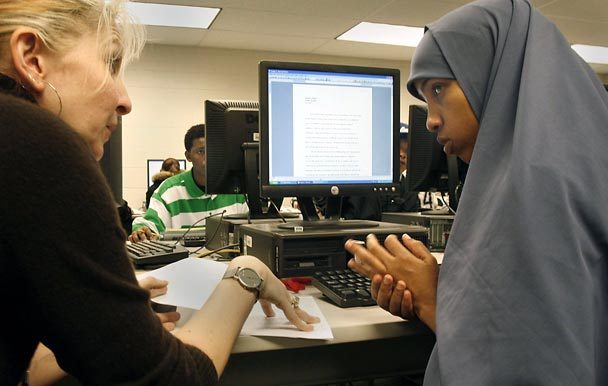 Lori Douglas opens the top drawer of her filing cabinet at
It's her job to help them pass, and she's signed up many of them for special math classes or other extra help. For those who are recent immigrants, however, she's not sure what to do. No matter how hard they work, she says, most haven't been in the country long enough to have much — if any — chance of passing a 10th-grade exam in English.
And that, she says, is "extremely unfair."
That's a sentiment shared by many of her colleagues in
"If you or I lived in a country less than one year, we'd never pass," said Sid Glass,
It's also a sentiment questioned by those who think that students shouldn't earn a diploma until they can demonstrate the required skills in reading, writing and math — in English.
"In truth, if they go out there with a diploma, and they're clearly four to five years behind, what will that diploma really do for them?" asked Ricardo Sanchez, board chairman of the nonprofit Latino/a Educational Achievement Project (LEAP).
The issue is under discussion at the Office of Superintendent of Public Instruction, which expects to announce recommendations to the Legislature soon.
"We are weighing the balance between the needs of those students and the meaning of a diploma, what a meaningful diploma is," said spokesman Nathan Olson.
Students who are learning English have a lower passage rate on the WASL than any other group reported — including students in special education (who have more options), and students who live in poverty.
In the past, immigrant students could graduate as long as they passed all required classes and met other graduation requirements such as community service. Classes often are designed specifically for students learning English.
Starting this school year, however, all students, with the exception of some in special-education programs, also must pass reading and writing on the 10th-grade WASL, or an approved alternative, to earn a diploma. (They must pass an additional math class if they fail math on the WASL.)
That requirement holds whether a student was born in
The goal is to ensure that a high-school diploma means something.
Many immigrant students work tremendously hard, said Nancy Steers, assessment coordinator for the
Yet that means some students, if they arrived a year or two ago, have no hope of graduating on time.
A growing body of research suggests it takes anywhere from three to seven years for newcomers to master "academic" English, which is more nuanced and requires more vocabulary than conversational English, according to Tom Stritikus, an associate professor of education at the University of Washington who studies bilingual and English-language issues.
It's important to have high standards for English-language learners, he said, but "holding people accountable after one or two years doesn't make a lot of sense."
When it comes to evaluating schools under the federal No Child Left Behind law, even the state superintendent's office has tried to convince the U.S. Department of Education that WASL scores of immigrant students shouldn't be counted for up to three years. But diplomas are a different matter.
In
In the
"All the WASL does is affirm what we already know — that they haven't mastered English," he said.
Soria will be in
They don't want to lower standards, but they want more time to help students reach them.
In Seattle and
Some suggest that English-language learners be allowed to graduate under a system that's similar to what's in place for students in special-education programs.
Special-education students, for example, can earn a diploma if they pass the fourth- or seventh-grade WASL instead of the 10th-grade test, if that's what their teachers judge is appropriate for them. They receive a diploma titled a "certificate of individual achievement" rather than a "certificate of academic achievement," but they graduate all the same.
Last year, Sanchez's organization lobbied the Legislature to open "career and college readiness centers" where students who don't graduate because they fail the WASL can continue their studies for free on nights and weekends.
"Give them that path, and let them work toward it," Sanchez said.
Some programs for nongraduates already exist at community colleges, and, under
But educators say many students don't want to stay in high school that long — and the other options aren't always clear to them.
At Sealth last month, Abdiwali Olad, 18, said he hopes to pass the WASL so he can go to
He moved to
"I'm trying to do my best," he said.
Alison Yount, who teaches ELL classes at Sealth, says Olad comes in after school every day for extra help, speaks three languages in addition to English, assists his classmates and couldn't afford college without a scholarship.
It's students like him she's worried about — and how the WASL might cause them to give up their dreams.