
Sunday, December 23, 2007
By Katharine Houreld
The Associated Press
It has sailed on a relief ship through seas plagued by pirates and sharks, then been carried ashore by porters into the hands of aid workers who have to contend with bandits, arsonists, insurgents and even the Somali government's own forces to get it to the hungry.
"
The United Nations says this Horn of Africa nation faces
Like many of her neighbors, Omar has taken in a relative, her daughter, seeking refuge from the violence in
 |
|
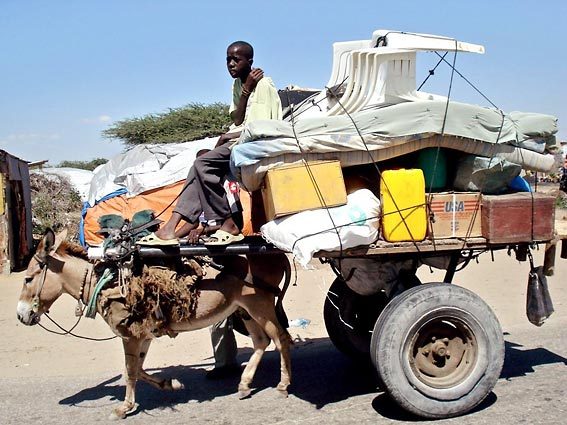
A Somali man rides a donkey cart with some of his belongings as he arrives at a camp for displaced people on the outskirts of conflict-torn |
"A mother cannot sleep when her children are awake with hunger," Omar said. But getting food to families like hers is tough.
Following three attacks on WFP ships by pirates this year, few ship owners are willing to risk their crews and cargo to deliver aid, and those that do demand exorbitant prices. Since last month, the merchant ships that deliver 80 percent of WFP's aid have been accompanied by French warships, and teams of elite French commandos camp on their decks, machine-guns at the ready.
Of the two ships escorted by the French navy ship Premier Maitre L'Her last week, one managed to evade an attack last May — although a guard was killed during the fighting — while the other was held for over a month last year.
The pirates demanded a $3 million ransom, but backed down after the ship's Somali contractors sent an army of bodyguards to the pirate camp to do battle.
Evading the pirates is only the beginning.
Stray bullets and mortars have killed several aid workers this year, and the years of fighting have devastated
Last week, ships coming from
A rickety flotilla of small boats sets out to meet the ships, ferrying sacks of grain through rough seas toward hundreds of porters waiting neck-deep in waters where aggressive bull sharks hunt.
Once the food is piled on the beach, aid workers organize its storage and transport through roadblocks manned by hungry gunmen. In the chaos of
The cost of moving a truck through roadblocks along the 20 miles from
Because of the instability, WFP uses local contractors such as Abakr Abdi Shire to move aid. He pays a bond for the value of the food; the bond is returned only after the food has been safely delivered. Shire has lost seven employees since he began working for WFP, five of them killed at checkpoints and the others by bandits.
If the trucks haven't broken down, the route hasn't been blocked by fighting or the food has escaped looters, the most dangerous part of the operation begins: distribution. At least 20 people have been killed at food-distribution sites this year.
Aid workers say the Somali government has inflamed tensions by describing its displaced citizens as terrorists and questioning why humanitarian agencies feed them. The agencies acknowledge a few armed insurgents may be in the camps but say it is impossible to individually screen the 1.5 million Somalis who need aid.
In October, the head of WFP in
Despite all the difficulties, last week's food shipment at least reached the hungry. It meant 40-year-old Faduma Hassan needn't spend her husband's 50 cents in weekly earnings on food and instead could buy medicine for her sick 4-year-old son.
And for Abiye Omar, the sack of grain at her feet meant a long stretch of quiet nights.