
MOMBASA, Kenya (AP) - With one slain crew mate in the ship's freezer and Somali pirates threatening to kill his son, Xinshen Ling could think of only one thing to do: Threaten to throw himself into the shark-infested waters, calculating the pirates wouldn't want to lose the captain.
He was right. Four pirates immediately rushed to keep him from jumping off the Taiwanese fishing vessel.
"It was a test. I wanted to see how much the pirates valued me. ... They know if the captain dies, they will get less ransom," the 47-year-old captain of the ship told the Associated Press, safe in Kenya last month after the U.S. Navy stepped in to win the release of the Ching Fong Hwa 168 and its surviving crew, including Mr.
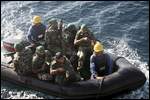 |
| Pakistani soldiers from the Pakistani warship PNS Babur carry out maneuvers in an inflatable boat recently in the Arabian sea. Following a rash of pirate attacks off the lawless Somali coast, an international coalition headed by a U.S. admiral has come up with a new strategy: to target the elusive pirate motherships preying on boats in one of the world's most important shipping lanes. |
Mr. Ling's tale of seven months of captivity is frighteningly common off the lawless coast of war-ravaged Somalia, where piracy is on the increase. After releasing the ship and its crew on Nov. 5, the pirates got away with an unspecified ransom paid by the ship's owner.
But Mr. Ling's story has a twist. When the pirates demanded even more ransom, the Navy intervened, a development that will continue in response to the spike in piracy, a Navy spokeswoman said.
Yesterday, two U.S. navy ships sailed near a hijacked Japanese chemical tanker to block supplies from reaching pirates on board, in a bid to secure its release.
The Golden Nori, carrying tens of thousands of tons of benzene, was hijacked on Oct. 28 along with its 23 crew members from Burma, the Philippines and South Korea.
"We have two U.S. Navy ships that are monitoring the Golden Nori right now, and we are taking appropriate steps to prevent resupply of the vessel," said Cmdr. Lydia Robertson, spokeswoman for the U.S. Naval Forces Central Command in Bahrain.
By blocking the supplies of the tanker, which was sailing from Singapore to Israel when it was hijacked, the Navy aims to force the pirates to abandon the vessel, she said.
The Golden Nori is the last vessel remaining under pirates' control off the Somali coastline after the Comoran-flagged cargo merchant vessel Al Marjan was released over the weekend.
Recalling his own ordeal, Mr. Ling said the worst aspect of the hijacking was when his son was threatened.
"The worst time for me was the times they took my son ... . They used this boy," said Mr. Ling, gesturing toward 22-year-old Linshangyi Ling, sitting across from him at a Chinese restaurant in the port of Mombasa. "They threatened me, said if I didn't call Taiwan, they would shoot my son."
There have been 26 ships seized by pirates off Somalia this year, up from eight during the same period last year, according to the International Maritime Bureau. But deaths are rare, said Andrew Mwangura, head of the East Africa Seafarers' Assistance Program.
"Most of the time the pirates want money, not to kill people," he said. Ransoms can reach millions of dollars.
Somalia is deeply impoverished and flooded with weapons. Its government has little authority on land, let alone the means to police its long coast, especially now that it's battling an Islamic insurgency.
Somali pirates are often fighters linked to the clans that have carved the country into armed fiefdoms. They have heavy weapons and satellite-navigation equipment, and have seized merchant ships, aid vessels and even a cruise ship.
Mr. Ling's ordeal began one sunny afternoon in April, when about 15 pirates stormed aboard his vessel armed with automatic rifles, machine guns and rocket-propelled grenades. His crew was unarmed, and one member was shot in the back. He survived, but when negotiations with the ship's Taiwanese owners were going badly, the pirates killed another crew member, 32-year-old Chen Tao from China.
"He was very unlucky because they just took him at random," said Mr. Ling, who had worked with Mr. Tao for two years. He remembers the sailor being grabbed out of a lineup, then six shots that rang out on the other side of the boat.
"We were in shock," said Mr. Ling, raising a dragon-tattooed arm to smooth a sprinkling of white hair. "Just for money, they took a life. ... They are not human."
"After they shot that guy, I was really afraid," said Linshangyi Ling, refilling his father's sake glass.
Four crew members were ordered to drag the man's body into the ship's freezers, where Mr. Ling insisted it stay. The pirates wanted to throw it to the sharks.
Over the next months, the crew battled scurvy when their vegetables ran out, endured frequent mock executions and occasional beatings from guards when the Chinese, Taiwanese and Philippine sailors didn't understand orders in Somali and broken English.
The pirates also forced crew members to call home, in hopes their families would pressure the ship's owners to pay the ransom. Mr. Ling listened to his wife weep for her son and husband.
Eventually, Mr. Ling explained through a translator, the ship's owners delivered a ransom in October — the pirates had demanded $1.5 million, but Mr. Ling refused to say how much was paid. The relieved crew thought they were going home, but the pirates held out for more money. That's when the Americans got involved.
The Navy said its personnel spoke to the pirates by radio, pressing them to leave the ship. They did on Nov. 5, aboard skiffs that took them to shore. Then a Navy vessel escorted Mr. Ling's ship out of Somali waters and gave its crew food and medical assistance.
Mr. Ling, who speaks no English, was not clear who had helped, saying he thought U.N. forces as well as the U.S. military were in the area.
U.S. officials would not say what was done to persuade the pirates to leave. But earlier, a U.S. naval vessel had fired on pirate skiffs tied to a Japanese-owned ship.
At one point in recent months, at least seven ships were being held. Now, following U.S. intervention, only the one cornered yesterday remains in pirate hands.
"We continue to talk with the pirates regularly, encouraging them to leave ships," said Cmdr. Robertson, the U.S. Navy spokeswoman. "It's not so much a change in focus as a change in activity. There is a spike in the number of pirated vessels. Since we were there when the ships were pirated, it was an opportunity for us to stay there and help free the ships."
Indonesia remains the world's worst piracy hot spot, with 37 attacks in the first nine months of 2007, according to the International Maritime Bureau. But pirate activity worldwide is on the rise, with the biggest increases off Africa, particularly lawless Somalia.
After being released last month, the crew of the Ching Fong Hwa 168 tucked into lobster and chicken at the Chinatown restaurant in Mombasa. Their ship was tied up safely, their families had been informed of their release and the men were enjoying their first taste of freedom — and sake — in seven months.
"To freedom," toasted one man in Bermuda shorts and plastic flip-flops.
"To home," said another.
SOURCE: AP, December 6, 2007