Muslims learn how to avoid interest

By Dan Linehan
The Free Press
As a devout Muslim, home ownership has been out of his reach.
Alasow’s religion prohibits him from charging or accepting interest. His only option, he thought, was to save up enough money to buy a house outright.
Hundreds of Muslim families in Mankato and across the country face the same plight.
It’s also a problem for public housing authorities like Mankato’s as they seek to move tenants from publicly funded apartment units into their own homes.
 click to enlarge click to enlarge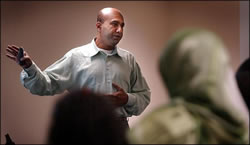 |
|
|
Alasow was positively gleeful after Sharieff’s presentation and said he has even chosen the house he wants to live in.
“I’m ready,” he said.
The Ijara method is like a typical mortgage, except with a few added steps to avoid the payment of interest.
Ijaraloans.com, or another entity, creates a trust, an entity that actually owns the home. In this case, the company would be the “trustee” and the consumer would be the “beneficiary” of the trust.
click to enlarge |
| John Cross / The Free Press |
So, from the consumer’s perspective, Ijara can best be summarized as “rent to own.”
Each month, the occupant pays rent for the house and a portion of that money goes toward the eventual purchase of the home. Much work has gone into making the Ijara process as cheap for the consumer as the typical mortgage, Sharieff said.
Islam, he said, encourages entrepreneurship and the charging of profit on goods (e.g. rent), but forbids the charging of profit on money (typically called interest). He said the rule is meant to discourage the wealthy taking advantage of the poor through unfair loaning practices.
Back home in Somalia, Halima Mumin says, families owned homes with backyards and everything, bought through traditional Islamic means. That’s especially important in Somalia, where it is typical to have eight, 10, even 15 children.
Source: Mankato Free Press, Aug 07, 2007