 |
|
|
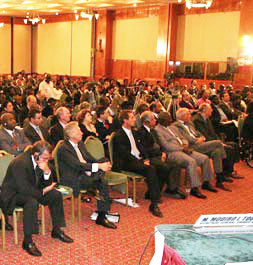
The first African Development Bank (AfDB) Group annual economic conference opened on Wednesday in Tunis. Held on the theme: “Accelerating Africa’s Development Five Years into the Twenty-First Century”, the conference brought together over two hundred and fifty participants, including many eminent researchers, economists, university professors and representatives of international organizations such as the World Bank, the World Trade Organization (WTO), UK-based DFID, the African Economic Research Consortium (AERC), the United Nations Economic Commission for Africa (UNECA) and senior government officials from across the world.
 The three-day conference will feature presentations from many experts. Topics to be discussed during the conference include, Lessons from Asia: The Experience of Korea by Professor Ji Hong Kim of the Sogang University in South Korea, Sources of Growth in Africa: Agriculture, Manufacturing, Services, ICT, Technology Base by Dr. Alan Gelb, World Bank Director, Export Capacity Constraints: Taking Advantage of Market Access, Branding, Networks, Supply/Value Chains by Professor Ademola Oyejide of the University of Ibadan in Nigeria, Africa in the World Trading System by Mr. Patrick Low of the WTO in Geneva, Capital Markets: Roles and Challenges by Professor Victor Murinde of the University of Birmingham, Commercial Banks in Sub-Saharan Africa by Professor Colin Kirkpatrick of the University of Manchester.
Mr. Kaberuaka advised that the AfDB had contributed enormously to the mobilization and deployment of resources for the socio-economic development of the continent, adding that the institution had financed projects and programs across a whole range of sectors including education, health, governance, capacity building, infrastructure, and agriculture.
He also said that the Bank had progressively stepped up its budget support operations where conditions existed for this type of support, adding that “this year alone, we hope to commit close to US$ 3.2 billion, excluding debt relief operations.”
He also indicated that as the premier development finance institution on the continent, the Bank was engaged in an internal exercise to determine how best to decisively canalize efforts that are aimed at enabling the continent meaningfully participate in the growing global prosperity. He however advised that there were no quick fixes to the continent’s development issues, advising that part of the Bank’s role was to promote a healthier investment climate, reduce the risks and costs of doing business in Africa and investing to unlock those bottlenecks that impede Africa’s competitive position.
Mr. Kaberuka indicated that moving the continent’s development agenda forward was a joint responsibility and despite the AfDB’s privileged position regarding African development, the Bank was committed to working with other development partners.
“…We make no pretence of attempting to be a monopoly on this voice, nor to be the sole depository of this type of capacity in Africa – far from it. We want this to be a shared agenda. The Bank is making use of its rallying potential to provide a forum for you to exploit the considerable knowledge and lessons it gathers from its operations, its economic and sector analysis to understand Africa better. I must reiterate that the Bank alone is not expected to address all the key development issues; neither will it try to do so. We will work in a complementary and an integrated way with your think-tanks and institutions across Africa and elsewhere,” the AfDB President said.
In welcoming participants, the AfDB Chief Economist, Louis Kasekende, focused on research and knowledge management within the Bank Group, indicating that the institutional reforms currently underway in the Bank recognize the critical role of knowledge in the continent’s effort to attain sustainable development. He underscored that the Bank had, in the medium and short term, set for itself the objective of enhancing its knowledge, research and dissemination capacity, adding that the Bank would assume a more prominent role in providing intellectual leadership on development issues on the continent.
“Research and knowledge are central to the operations of the AfDB. In order for the Bank to have a profound grasp of major development issues, it must deepen its analytical capacity to bring to bear the insights of modern development theory on the specific challenges that African countries face,” Mr. Kasekende said.
He advised that one of the objectives of the economic conference was to link national policy-makers with leading experts and researchers, adding that developing partnerships in this regard will go a long way in helping the continent achieve its development objectives.
“By bringing together leading researchers and policymakers to deliberate on issues of common interest such as are before us, we expect outcomes that would be mutually satisfying. In this light, the output of this AEC, in terms of the papers presented and the discussions thereon will be published for widest possible dissemination among African policymakers in regional member countries, international organizations, donor organizations and other stakeholders in Africa’s development.”
In a keynote address, Professor Patrick Guillaumont of the French-based CERDI, focused on the continent’s economic vulnerability. In his address: Economic Vulnerability, Still a Challenge for African Growth, Professor Guillaumont indicated that structural economic vulnerability was still high in Africa, highlighting the relationship between vulnerability and human capital, suggesting that structural vulnerability could lower human capital, and this could in turn be detrimental to economic growth.
The Microsoft Africa Chairman, Cheick Diarra, for his part, focused on human resources development on the continent. He called for the development of infrastructure across the continent, adding that the global community was ready to assist development efforts in Africa. He, however, advised that the continent which is naturally endowed should count on its own ability and resources, suggesting that external aid should only help to accelerate development efforts currently underway on the continent. He regretted that there were no knowledge banks in Africa, adding that if the continent had to lay claim to the twenty-first century, then the right policy measures and decisions had to be taken.
The conference was inaugurated by the Tunisian Secretary of State for Maghrebian, Arab and African Affairs in the Ministry of Foreign Affairs, Slaheddine Jemmali, who indicated that Africa had to be in charge of its own destiny, adding that intra-African dialogue was necessary for the sharing of experiences. Tunisia, he said, had its own successful experiences and that it needed to share those experiences with other African countries, adding that Africa was capable of achieving great feats because of its natural and human resources.
Contact: Joachim Arrey, 216-7110-2612, email [email protected]
Source: AfDB, Nov 22, 20066