
Tuesday, November 21, 2006
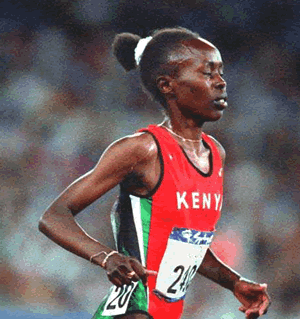 KAPENGURIA, Kenya - At least for one day, hundreds of warriors in northwest Kenya put down their guns and laced up their sneakers in a race for peace
between tribes that have clashed over cattle for generations.
The runners, some wearing traditional kilts, beads and earrings, traversed the hilly 10-kilometre course on Saturday during the annual Tegla Loroupe Peace Race, founded by the Kenyan track legend who won back-to-back New York Marathons in the mid-1990s.
Loroupe, 33, created the race in 2003 to quell increasingly deadly violence over cattle rustling that has killed hundreds of members of her tribe, the Pokot, and neighbouring groups in northwest Kenya and Uganda.
She blamed illiteracy and poverty for the escalating violence, but said tensions have diminished considerably since the first race three years ago.
"I have seen a lot of understanding among our communities," Loroupe said during the competition in her western Kenyan hometown of Kapenguria, about 480 kilometres from Nairobi.
"These races have continued to provide an enabling environment for everybody to mingle freely with each other, the rich, the poor, there is no category," she said.
"You have seen we don’t even have any security."
The competition has given new direction to the lives of some warriors. Two years ago, Pokot warrior Mark Lokitare traded his AK-47 automatic rifle for running shoes to compete in the race.
Since then, Lokitare has become a hero in the Pokot community, addressing the United Nations (UN) and meeting outgoing UN chief Kofi Annan. He has joined a
training camp for elite athletes and plans to run his first international marathon next month.
Michael Ekodous, a former cattle rustler from the Turkana tribe of northern Kenya, sold his goat to raise the money to get to this year’s race. But the sacrifice has already paid off: last year, he was awarded a heifer for finishing first in his tribe.
Ekodous says the race has inspired him to trade his life as a cattle rustler for a career as a professional runner. "I want to train and become a big athlete," he said.
Among several foreign dignitaries attending this year’s race was US ambassador to Kenya Michael Ranneberger, who said tribal conflicts in Kenya are being fuelled by weapons smuggled in from Somalia and Uganda.
"The borders are so porous," he said. "Arms are coming into the country and they are not well regulated. It has raised the conflict from the traditional bows and arrows."
Cattle rustling and revenge attacks are endemic in the region and have become worse in recent months due to the effects of a searing drought that killed tens of thousands of livestock and depleted already sparse water and pasture.
At least 150 people have been killed in the past five months as longstanding tensions have intensified between local tribes and clans, notably Borana and Gabras as
well Pokot and Turkana. But, Ranneberger said, Loroupe’s annual race has fostered peace by engaging communities in positive activity.
"Sport is a universal way of helping to resolve conflict and building understanding between different ethnic groups," he said.
Loroupe said the race has calmed tensions in the region and, as a result, inspired four 12-year-old girls from Uganda’s remote northeastern Karamoja region that borders Kenya to attend school.
"It’s a big achievement," Loroupe said. "Women can go for their shopping without the fear of being kidnapped or killed. It is through running that they are able to come together."
Source: AFP, Nov 21, 2006