Mon Dec 19, 2005 8:12 AM ET
By Guled Mohamed
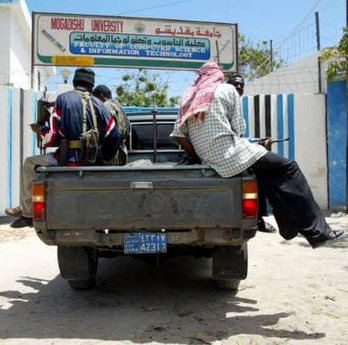 |
Somalia gunmen sit in their van outside the Mogadishu University Faculty of
Computer Science and Information Technology in the capital Mogadishu in this
October 24, 2003 file photo. In gun-infested Mogadishu, students and lecturers
defy bullets every day, determined to keep education alive in Africa's most
anarchic city. Outside the university's walls, heavily armed militias, working
at the behest of warlords, prowl Mogadishu's decaying streets, 14 years after a
militia-led coup toppled dictator Mohamed Siad Barre and ushered in years of
chaos. Picture taken October 24, 2003. To match feature Somalia-University.
REUTERS/Antony Njuguna |
MOGADISHU, Somalia (Reuters) - In gun-infested Mogadishu, students and lecturers defy bullets every day, determined to keep education alive in Africa's most anarchic city.
Eight years after Mogadishu University opened, hundreds of new students have signed up for classes, keen to get a degree despite living in one of the world's most dangerous cities.
Outside the university's walls, heavily armed militias, working at the behest of warlords, prowl Mogadishu's decaying streets, 14 years after a militia-led coup toppled dictator Mohamed Siad Barre and ushered in years of chaos.
"Students and lecturers are sometimes forced to lie down in between lectures and even during examinations as rival factions exchange fire," said one of the school's founders, Hussein Iman.
"Once a ceasefire is agreed, then students and lecturers carry on."
A group of lecturers from Somalia, India and Kenya teach 3,000 students at the university -- three semi-completed buildings, comprising classrooms, a library and living quarters in a sparsely populated area of north Mogadishu.
Around 800 new students joined the university this year.
For security reasons, the foreign lecturers hardly ever see central Mogadishu, a city of 1 million people where militia fighters, sometimes in trucks mounted with anti-tank machine guns, patrol dirty streets lined with pock-marked buildings.
Iman, a 55-year-old California-trained agriculturist, and others opened the university in 1997 with backing from the Somali diaspora and Islamic relief agencies.
The university's oldest student, former army officer Mohamed Hashi, who at 62 is studying business administration, said he does not mind the bullets, since he believes education is the only way Somalia can lift itself out of ruin.
"Knowledge is power, and I'm happy to seek it at this old age," said Hashi, whose daughter graduated from the university in 2000. "I urge my fellow students to work harder and call upon the world to support education because ignorance is the source of chaos in Somalia."
"MIDDLE OF ANARCHY"
Somalia's National University, which had 15 faculty groups, 5,000 students and 700 teachers, collapsed during the chaos after 1991. In 1993, a group of former professors and intellectuals decided to open a new university, but militia fighters looted the premises and the project was suspended.
The new college finally opened in 1997. It was recently ranked 79th out of 100 African universities in a survey by Interlab, a Spanish research group, despite operating in a nation without an effective government since Barre was ousted.
The school has appealed for $35 million from donors to finish building the campus. Staff members hope this will draw foreign students and Somalis living in other countries to Mogadishu -- and help open up the city to the world.
But that dream may take some time to realize.
Recently, rival militia groups fought a fierce battle on a stretch of wasteland next to the school.
Somalia's transitional government, formed last year in Kenya, is deeply split and has yet to make its impact felt in Mogadishu, still divided into a patchwork of militia fiefdoms.
Yet, the school's staff are optimistic.
"People are impressed by what we have achieved in the middle of anarchy," Iman said in his office as shots rang out nearby.
"I was shot but came back again to continue educating my people," he said, pointing to the scar on his left hand from a 1995 incident. He does not know why he was shot.
Stephen Amiani, a nursing lecturer from Kenya, said he has high hopes for the school -- despite the fact that every time he steps off campus, he is protected by dozens of militiamen.
"As soon as facilities are complete I believe we will climb higher in the rankings," he said
The college runs four-year courses in Islamic law, English, education, Arabic, economics, computer science and nursing.
The courses are open to men and women and students pay $400 per year -- a large sum for many ordinary Somalis. The fee covers a third of running costs per student, with charities and remittances from Somalis living abroad covering the rest.
The college also offers a chance to students who otherwise might have no opportunity for higher education.
"It's been very hard for my parents to educate me," second-year scholarship student Abdinasir Abdullahi, 20, said. "It's time for us to stop this useless war and get education which pays more decently than guns."
"FLYING BULLETS"
Swammy Paravasthu, an Indian economics lecturer who previously taught in Eritrea and Ethiopia, thinks his students do remarkably well given the daily pressures.
"The social tensions have given them an urge to study," he said. "Students are very serious here and are very inquisitive."
Most of the Somali lecturers spent their early careers overseas but returned to Mogadishu's mean streets because rebuilding Somalia, they say, means more to them than the comforts of expatriate life.
Sharif Osman, a bespectacled 45-year-old, brought home his expertise in computers after spending two decades in Canada. People in Mogadishu cherish his contribution, he said, whereas he was more or less unknown in Canada.
"Canada does not need my talent," he told Reuters, "People need my skills here and respect me."
Iman feels the school has made enough progress to allow him to think about retiring soon. He looks forward to watching his own children graduate from Mogadishu University.
"I don't think there is an institution that could achieve anything in this kind of environment. It's been terrible. We have been operating under flying bullets but I can safely rest now."
Source: Reuters, Dec. 19, 2005




