By Omar Ugas
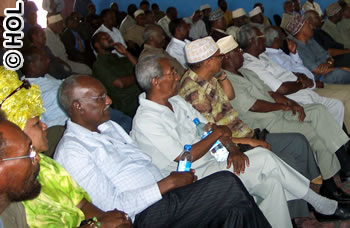 |
Somali MPs at Baidoa, Somalia
|
As a professional social worker whose job can be normally described to help people help themselves and develop their own lives; I want to forward here a bit of advice to the members of the Somali parliament, who are currently in Baidoa, Somalia, for an extraordinary session.
First I would like to start by reminding you some of the causes of Somalia’s internal and external disasters. I think the problem started from the colonial times in 1884 - 1960, the independence period, the civilians rules (1960 - 1969), the military rule (1969 - 1991), the civil war and the United Nations military intervention in 1992-1995.
Again, our people were fighting for power struggle in years but the world is still watching us. What is more, our clanism culture, which was first used and encouraged politically by the colonial powers for their own interests of divide and rule, is still part of Somalia’s political life in terms of understanding, communication, and sharing the governments positions.
In addition, after the collapse of the Somali government in 1991, and the civil wars, most of you remember that all countries, even the former Soviet Union were busy with the preparation of the Gulf war when Somalia was at its boiling point. Besides, when the Gulf war started on July 17, 1991 it completely shadowed the flaming Somalia, just the same as the Iraq war is shadowing now many of other world problems including Somalia.
Second, I would like also to put your attention that conflict resolution skills are not a "given". We are not born with them readymade but as with any science or art form they have to be learned and practised. Moreover, conflict is built into every process of change, so policy makers must deal with conflict all the time in everyday life.
In fact, as it is viewed some times by many Somalis, conflict is not the same as violence; rather it can be positive and constructive by opening avenues of change if managed effectively. Meanwhile, most of the Somalis must have good experience that conflicts are likely to arise in circumstances where resources are scarce such as, food, employment, housing, and water availability.Where poor or no communication exists between parties, and have incorrect perceptions of each other. Where there is a lack of trust, unresolved grievances exist from the past, parties do not value the relationship between them, and power and resources are unevenly distributed.
Maybe that is why many Somali clans feel injured in many aspects by other clans. They appear pushed apart by the injury, and so if they are about to come together again, they need to repair the gap that was created between them. They must be reconciled. According to Webster’s Dictionary, reconciliation comes from the latin words, re-, meaning “again” and conciliare, which means “to bring together”, or “to make friendly again.” Thus, the act of reconciliation involves two parts: Forgiveness and apology.
On the other hand, reconciliation in a common sense is about working with existing problems, role functioning, choices to be made and actions to be taken. It is more concerned with present events than past events, with conscious and rational thinking.
Furthermore, experts in human behaviour suggest that one should not try to change others by imposing and controlling them but rather by giving them advice to face up and heal their own inner lives. They argue that until we make peace with ourselves it will not be possible for us to live peace with others. This means, in this world you can only change yourself and others can change themselves too only by their willingness and readiness. The hope is that your exemplary leadership to serve with the people as their servant and by putting first the common interest might influence others to trust you and change themselves towards working with the common cause. This is how it works in families, in communities, in countries and in life generally, if the Somali parliament wants to do so.
For instance, based on my social skills and experience, if the person in the leadership is there for power, money, and fame, he/she cannot be trusted. On the contrary, people would trust the leader who is not selfish but a giver and not concerned about getting pleasure or security. This is a hard work that can be done only by a true sacrificed leader, who would not seek leadership without the necessary knowledge, modesty, and submission.
Of course, many of you can understand that laws are made to determine where one person's rights end and the next person's rights begin. Hence, to make Somalia peace, I think we need some form of international armed forces and a means of enforcing them, so that even President Yusuf should have no more right to kill than the civilians do. However, if international armed forces are not available, it is up to Somali parliament to make their house in order. Because they are the lawmakers, it is their duty to authorize a government that can maintain security and stability.
Undeniably, it is imperative that many of the members of the Somali Parliament at least convince to the people and to themselves that they are not warlords or killers anymore. They should also make certain to the World and to the Somalis that Somali citizens can refuse to take Warlord’s orders to kill others, just as no one has the right to kill anyone else. No clan should have a right to invade others, kill people or take their properties.
Without reservation, the Somali people expect from their parliamentarians to stop injustice, fix mistakes, change things for better, empower the people and ensure fair treatment for all Somalis. For example, in their sessions, members of the parliament have to let their anger motivate and give them energy, and not to express it negatively. He/ she should appear calm, cool, and collected when expressing his/her views. Members must be trained to be concise when describing the problem, treat others as they would like to be treated, with respect and courtesy. Further, I hope that the Nairobi history of March 17, 2005, will not repeat itself. Without a doubt, if it repeats in Baidoa, this time the price will be higher.
After all, a position like that of a parliamentarian, one should be flexible and open minded to find a win/win solution to the problem. It is time that members of the Somali parliament put the interest of their failed country and people before everything else with collaborative approaches of positive -sum gains, and working together to address problems jointly. They must increase their levels of trust by genuine communications and improving their relationships.
Positively, it is time to stop thinking of victory and defeat mentality, as you are there only to defend for one general national interest. Enough is enough. The people you’re representing are tired of looting, living in a refugee camps, hitting, beating, raping, stabbing, shooting, shelling, and bombing. It is time to understand and work with peace, trying to reach your goals through mutual understanding, without hurting anybody, developing new ideas, and attempting to reach for what you can actually grasp.
In brief, at this time, I am not thinking of how much education an experience each of you may have, or where you get it from. What I am asking you is the awareness of the needs of the people, your awareness of the challenges you face, your eagerness for improving things, and creating new opportunities. I am requesting that you show responsibility, have a passion for the Somali cause and to give something back to your people. I believe that if you care enough, you will accomplish a lot.
Thank you,
Omar Ugas, Master of Social Work/Registered Social Worker
Ottawa , Canada
E-mail: [email protected]