Tuesday August 19, 2025
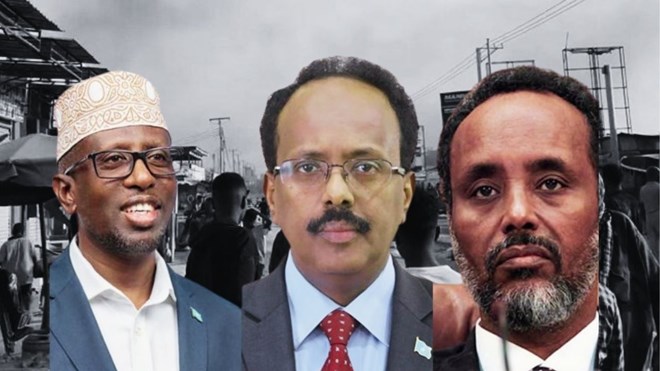
Former Somali Presidents Sharif Sheikh Ahmed (left), Mohamed Abdullahi Farmaajo (center), and Abdiqasim Salad Hassan (right) jointly issued a statement on August 19, 2025, condemning the government’s handling of public land in Mogadishu and accusing President Hassan Sheikh Mohamud of violating constitutional safeguards.
Mogadishu (HOL) — Three former Somali presidents have condemned the government’s handling of public land in Mogadishu, accusing President Hassan Sheikh Mohamud of violating constitutional safeguards and forcibly displacing poor families.
In a joint statement Tuesday, Abdiqasim Salad Hassan, Sharif Sheikh Ahmed, and Mohamed Abdullahi Farmaajo called on the government “to cease the exploitation of public property and the oppression of vulnerable citizens whom he swore to serve.”
The statement began with a note of condolence for those caught in the violence. “First and foremost, we extend our condolences to the families and relatives of those who lost their lives during the operations concerning the misuse of public land currently taking place in Mogadishu. We say: May Allah have mercy on those who died and grant a full recovery to the injured.”
The statement began with a note of condolence for those caught in the violence. “First and foremost, we extend our condolences to the families and relatives of those who lost their lives during the operations concerning the misuse of public land currently taking place in Mogadishu. We say: May Allah have mercy on those who died and grant a full recovery to the injured.”
advertisements
The former leaders anchored their warning through multiple provisions of Somalia’s Provisional Constitution and national laws that regulate how public land must be managed, including Articles 25, 26, and 43 of the Constitution, Articles 50 and 51 of the Public Financial Management Act, and Articles 6 and 22 of Law No. 41 on land distribution.“These provisions all require that, when land is removed from the public register, it is mandatory to ensure the following:” the statement said.
The statement added that when public land is taken off the national register, the process must be governed by law and handled with transparency and fairness. It outlined a series of requirements: citizens must be guaranteed the right to live in a safe and healthy environment; land sales must be justified as genuinely necessary; and the National Procurement Authority must oversee all transactions. Any sale must be publicly announced in the Official Gazette and displayed in gathering places. The principles also call for equal access to land and fair resource distribution, sustainable use that does not cause environmental damage, proper resolution of disputes, regulation of the land market to prevent exploitation of small landowners, and the deposit of all proceeds into the Central Treasury.
The statement added that when public land is taken off the national register, the process must be governed by law and handled with transparency and fairness. It outlined a series of requirements: citizens must be guaranteed the right to live in a safe and healthy environment; land sales must be justified as genuinely necessary; and the National Procurement Authority must oversee all transactions. Any sale must be publicly announced in the Official Gazette and displayed in gathering places. The principles also call for equal access to land and fair resource distribution, sustainable use that does not cause environmental damage, proper resolution of disputes, regulation of the land market to prevent exploitation of small landowners, and the deposit of all proceeds into the Central Treasury.
“Every citizen has the right to live in an environment that does not harm their health or quality of life,” it noted.
The leaders presented three demands to President Mohamud: to halt the exploitation of state property, to resettle those displaced in accordance with their constitutional right to adequate housing, and to return public land to government control unless its disposal follows legal procedures. They also directed a warning at the business elite, urging them not to be “deceived by the public land that belongs to the nation as a whole” or participate in “the corruption and looting of national property.”
The joint declaration comes on the heels of violent clashes in Mogadishu last week over a disputed public land takeover. On August 14, Somali security forces fought with armed militia resisting a federal government order to reclaim Horseed Stadium near Tarabuunka junction, a site that had been occupied by civilians since the collapse of the central government in 1991.
The Somali Police claimed the operation was carried out to “enhance security and combat illegal weapons in the Banadir region,” but acknowledged that it resulted in deaths and injuries among civilians, security personnel, and militia fighters. Residents fled the Hodan district as gunfire spread, and hospitals reported treating wounded civilians, including young people caught in the crossfire.
The standoff stemmed from a government order issued months earlier for residents to vacate to make way for a redevelopment project. The plan was met with resistance, with many accusing the government of prioritizing commercial interests over the rights of long-settled families.
The joint declaration comes on the heels of violent clashes in Mogadishu last week over a disputed public land takeover. On August 14, Somali security forces fought with armed militia resisting a federal government order to reclaim Horseed Stadium near Tarabuunka junction, a site that had been occupied by civilians since the collapse of the central government in 1991.
The Somali Police claimed the operation was carried out to “enhance security and combat illegal weapons in the Banadir region,” but acknowledged that it resulted in deaths and injuries among civilians, security personnel, and militia fighters. Residents fled the Hodan district as gunfire spread, and hospitals reported treating wounded civilians, including young people caught in the crossfire.
The standoff stemmed from a government order issued months earlier for residents to vacate to make way for a redevelopment project. The plan was met with resistance, with many accusing the government of prioritizing commercial interests over the rights of long-settled families.
Public anger has been fueled by a series of recent evictions in Mogadishu. In late December 2024, security forces demolished homes in Hamar Jajab district, prompting protests from residents who said they were given no notice or compensation. Earlier that month, families were forced out of Soviet-era housing in the Kalluunka neighbourhood, and in July 2024, authorities cleared residents from land claimed by the Interior Ministry.
Parliament has raised its own alarm. In January, 97 lawmakers accused Villa Somalia of misappropriating public property, warning that plots once allocated for schools and hospitals were being illegally acquired.
Somali think tanks have described the country’s land governance system as fragmented and vulnerable to abuse, with overlapping statutes and weak enforcement fueling disputes. Rising land values in Mogadishu, they note, have made public property a flashpoint where politics, commerce, and survival collide.
Parliament has raised its own alarm. In January, 97 lawmakers accused Villa Somalia of misappropriating public property, warning that plots once allocated for schools and hospitals were being illegally acquired.
Just months earlier, in January 2025, former President Sharif Sheikh Ahmed, ex–Prime Minister Hassan Ali Kheyre, and opposition MP Abdirahman Abdishakur Warsame issued a similar joint statement warning against the illegal acquisition of public land in Mogadishu.
Humanitarian agencies say the scale of forced evictions is worsening. The Norwegian Refugee Council reported in December that 143,500 people were displaced in 2024, with 82 percent of cases in Mogadishu. The UK Home Office noted in July 2025 that internally displaced people now make up more than one-third of the capital’s population, with “state-sponsored evictions” a primary driver.Somali think tanks have described the country’s land governance system as fragmented and vulnerable to abuse, with overlapping statutes and weak enforcement fueling disputes. Rising land values in Mogadishu, they note, have made public property a flashpoint where politics, commerce, and survival collide.
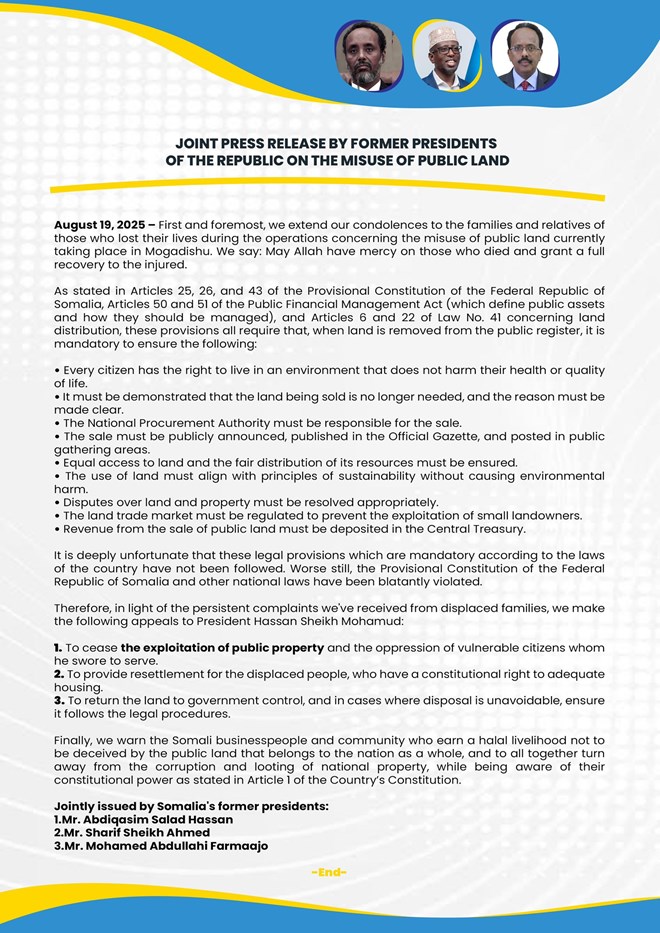
FULL STATEMENT BELOW: